
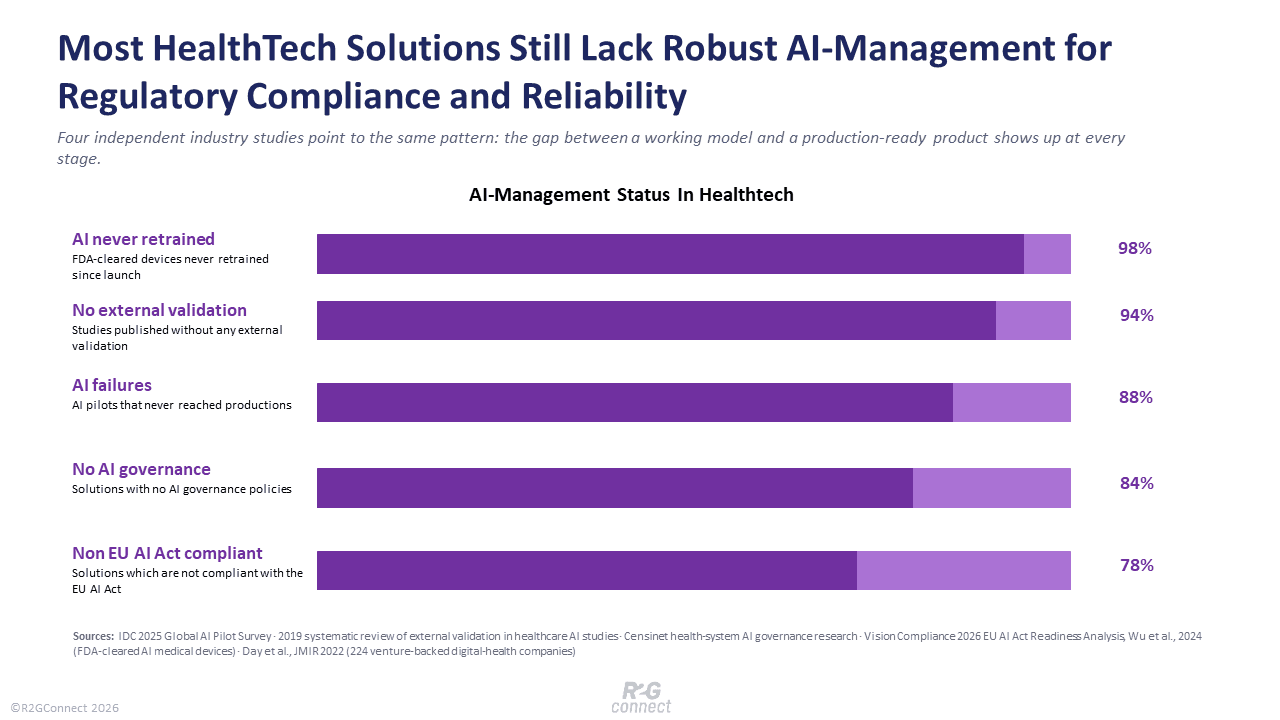
A gap that opens after the model already works
Ask an early-stage HealthTech team how their AI model performs, and most can answer confidently — with a metric, a benchmark, a slide. Ask the same team how that model will be validated against a real clinical population, monitored for drift once it's live, or explained to a regulator under the EU AI Act, and the confidence tends to thin out.
But any expert would tell you that’s to be expected. These are genuinely two different bodies of work, and the data backs that up.
One study tracked 224 venture-backed companies and scored each on clinical robustness — completed trials, regulatory filings, the kind of evidence that shows a product actually does what it claims. Nearly half scored zero.[1] Only one in five reached a level the researchers considered rigorous. These weren't seed-stage companies caught early either — the median company had already been operating for years.
The pattern holds up in more recent, AI-specific research too.
A 2026 study asked sixteen early-stage HealthTech founders what was actually hardest about getting their product to market — and regulatory and ethical compliance topped the list, ahead of the technical build itself.[2] What's telling is that these founders weren't in denial about it: four out of five said they'd welcome shared data and governance infrastructure, and three-quarters were open to a formal readiness assessment.[2] They already know where the gap is. What most are missing is a structured way to close it.
Why the gap tends to stay open
Left unaddressed, this plays out in fairly consistent ways across AI-driven HealthTech companies:
- Validation gets treated as a one-time milestone, not something to maintain. In an analysis of FDA-cleared AI devices, fewer than 2% had been retrained on new data since launch — yet the same research found accuracy can drop meaningfully, in one documented case by 0.18 AUC, purely from being used at a different clinical site.[3] A model that passed validation once isn't the same as a model that's still valid a year later.
- Deployment surfaces problems no prototype ever sees. NHS England evaluated thirteen AI technologies that had already cleared their technical and regulatory hurdles — and still ran into sites that didn't participate, usage lower than expected, and not enough real-world data to draw firm conclusions.[4] The technology worked. The rollout didn't.
- Regulatory readiness has become an operating requirement, not a document to file away. NHS procurement now expects evidence on clinical safety, data protection, cybersecurity, interoperability and usability — assessed together, not ticked off one at a time.[5]
- None of this is news to founders. As above, regulatory and governance concerns are already what early-stage HealthTech teams say is hardest.[2] This isn't a blind spot that needs pointing out — it's a problem founders are living with daily and need real structure to solve.
Why the usual routes don't quite solve it
Founders who go looking for help here tend to run into two limited options:
- One-to-one regulatory and validation consulting gets real expertise, but it's priced and scoped for companies much further along. A straightforward regulatory submission commonly runs $17,500–$50,000; an EU MDR technical file for a mid-tier device is €15,000–€60,000; even a short strategy sprint for an early team starts around $3,500.[6, 7] What a founder gets back is a document — not the judgment to keep updating it every time the product or the regulation changes.
- Generic AI governance frameworks and checklists are free but written for no product in particular. The specifics that actually determine what a validation or monitoring plan needs to cover — intended use, deployment environment, the population it will serve — are exactly what generic material can't tell a founder.
The market isn't getting more patient about this either. Digital-health funding hit its lowest deal count in a decade in 2024 — even as AI-focused companies pulled in 42% of everything invested.[8] Money is still moving; it's just moving toward companies that can actually show their validation and traction, not just a working demo.
Closing the gap: what Expert Cohorts are built to do
This is the problem R2GConnect's Expert Cohort model exists to solve. Expert Cohorts are, at their core, a service innovation: a structured way of making senior, practitioner-level expertise accessible to early-stage startups at a fraction of the cost of one-to-one consulting, by having a small group of founders work through the same curriculum in parallel, guided by real experts rather than generic content. The intent is to democratize expert advice — making guidance previously reserved for later-stage, better-funded companies available to founders much earlier, while it can still shape how the product is built.
The newest cohort built on this model is the AI Validation & Deployment Accelerator, delivered by Punktum Digital GmbH, a team that has been building digital health AI products since before it was fashionable to, including work with early-stage teams at Charité and the German Heart Centre in Munich.
Over six weeks, startups work through their own model; producing a validation plan, a model risk and data governance assessment, a deployment architecture blueprint, a monitoring and drift strategy, and an MDR/EU AI Act readiness plan, brought together in a final go-live and scaling roadmap. Weekly expert-led workshops and individual sessions with Punktum's in-house AI/ML and regulatory specialists turn each week's work into an audit-ready deliverable, with confidential model and clinical data handled under ISO 27001-aligned controls throughout.
It's a reasonable fit for a team that already has a working AI product, prototype, or proof of concept and is now facing the harder question of what it takes to deploy, monitor, and scale it responsibly — particularly ahead of a funding round, a pilot, or a regulatory review where "it performs well" is no longer a sufficient answer.
The details: 6 weeks · cohort size 4–6 startups · starts 14 September 2026 · apply before 1 September 2026 · from €5,000 (early bird before 21 August).
Learn more and apply on R2GConnect →
Notes 1. Day et al., “Assessing the Clinical Robustness of Digital Health Startups,” JMIR, 2022 — 224 venture-backed digital-health companies. 2. Surodina et al., “Now You See Me: Designing Responsible AI Dashboards for Early-Stage Health Innovation,” 2026 — 16 early-stage HealthTech startups. 3. Wu et al., “Regulating AI Adaptation: An Analysis of AI Medical Device Updates,” 2024 — analysis of FDA-cleared AI medical devices. 4. NHS England, “Planning and Implementing Real-World AI Evaluations — Lessons from the AI in Health and Care Award,” 2024 — 13 Phase-4 AI technologies. 5. NHS England, Digital Technology Assessment Criteria (DTAC) guidance and related AI procurement guidance. 6. MedDeviceGuide, medical device regulatory consulting cost benchmarks, 2026. 7. ISOFAC, EU MDR and ISO 13485 consulting cost benchmarks. 8. CB Insights, “State of Digital Health 2024.”