
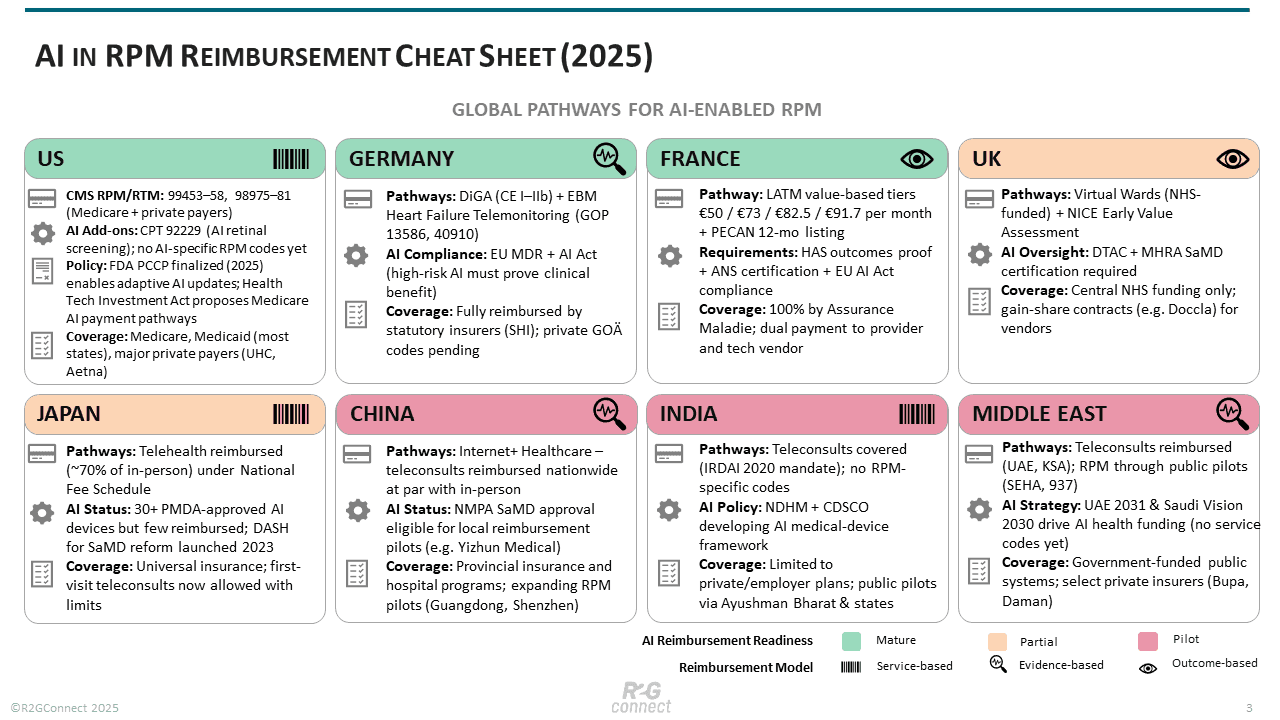
How reimbursement models are evolving to support the next generation of AI-driven remote care
Remote Patient Monitoring (RPM) has quickly become one of the most dynamic areas in digital health, connecting patient data, sensors, and clinical dashboards across hospitals, homes, and everything in between. Now, AI is redefining what RPM can do, turning streams of data into early warnings, predictive insights, and proactive care.
Yet one question remains: who’s actually paying for it?
Technology is advancing faster than policy, and reimbursement often determines whether innovation survives beyond pilots. So, how are health systems around the world paying for this new wave of AI-driven RPM? Let’s explore how different regions are building, testing, or struggling to build the financial playbook for the next generation of remote care.
United States: CPT Codes, Medicare Coverage, and AI Integration
The U.S. remains the most structured market for RPM reimbursement, with defined Current Procedural Terminology (CPT) codes reimbursed by Medicare and increasingly adopted by private payers. Reimbursement codes for RPM solutions generally cover the setup process, the device itself, and the ongoing patient monitoring.
Examples are:
- 99453 – Initial setup and patient education
- 99454 – Device supply and data transmission (at least 16 days per month)
- 99457 – First 20 minutes of clinical review and interaction
- 99458 – Each additional 20 minutes of management
- 99091 – Manual collection and interpretation of physiologic data
Or RTM (Remote Therapeutic Monitoring) Codes:
- 98975–98981 – Similar structure, focused on respiratory, musculoskeletal, or behavioral data captured through digital apps.
These codes allow providers to bill for continuous monitoring, data review, and clinical engagement, forming the foundation of the RPM business model in the U.S.
However, AI-specific reimbursement is still limited. Only a few codes recognize autonomous AI services, such as CPT 92229 for automated retinal image analysis in diabetic retinopathy screening. Most AI tools are still billed under traditional RPM or diagnostic codes.
The proposed Health Tech Investment Act (S.1399) aims to change this by mandating Medicare to define reimbursement pathways for FDA-approved AI/ML medical devices. The FDA’s Predetermined Change Control Plan (PCCP), finalized in 2025, also boosts payer confidence by allowing AI devices to evolve safely post-approval.
Private payers are starting to test outcomes-based and gain-sharing models, where vendors are paid based on avoided hospitalizations or improved outcomes. This signals a broader shift from volume-based to value-based payment for AI-enabled remote care.
Germany: Disease-Specific RPM and DiGA Digital Apps
Germany’s dual digital health reimbursement model stands out in Europe: 1. DiGA Fast Track: The world’s first prescription pathway for digital health apps (Digitale Gesundheitsanwendungen). Once approved by BfArM, DiGAs are fully reimbursed by statutory health insurance covering more than 73 million citizens. Some AI-powered RPM and symptom-analysis apps already qualify.
2. Telemonitoring for Heart Failure: Since 2022, 12 new EBM (GOP) codes cover RPM for chronic heart failure, such as:
- GOP 03325 / 03326 for patient education and coordination
- GOP 13586 for physician monitoring
- GOP 40910 for equipment reimbursement
These codes pay fixed monthly fees to both physicians and telemedicine centers, integrating RPM into standard care.
Reimbursement follows proven “positive healthcare effects,” while AI-specific pricing remains in development. The EU AI Act will classify most medical AI systems as “high-risk,” meaning compliance and transparency will soon become prerequisites for reimbursement.
France: Outcomes-Based Telemonitoring Payments
France officially launched nationwide telemonitoring reimbursement in 2023, following the ETAPES pilot. Two monthly payments are now recognized:
- A provider fee for clinical oversight
- A technical fee for the digital solution provider
The technical fee is tiered by demonstrated benefit:
- €50 per month for organizational improvements
- €73 for improved quality of life
- €82.50 for reduced morbidity
- €91.67 for reduced mortality
This outcomes-based model directly links reimbursement to measurable clinical impact. AI-enabled RPM providers such as ComuniCare, certified by the French Digital Health Agency (ANS), now receive monthly payments from the national insurer for chronic disease monitoring — setting a new standard for value-based reimbursement.
Nordics: Codes Exist, but Adoption Lags
Nordic countries combine advanced digital infrastructure with universal public funding. Telemonitoring for chronic diseases is reimbursable under regional budgets or DRG frameworks, yet explicit RPM billing codes are rarely used due to budget-based financing instead of fee-for-service.
AI-enabled monitoring is typically deployed through publicly funded pilots, such as Sweden’s AI diabetic retinopathy screening and Denmark’s home monitoring for high-risk pregnancies. Centralized budgeting and strict evidence requirements remain the main barriers to broader adoption.
United Kingdom: NHS Virtual Wards and AI Pilots
The NHS does not use per-service billing. Instead, centralized “Virtual Ward” programs integrate remote monitoring into standard care funded by NHS England.
AI-enabled RPM is expanding through the NHS AI Lab and NICE’s Early Value Assessment, which accelerates provisional reimbursement for digital tools. Startups like Doccla partner with NHS Trusts under gain-share contracts, where payments depend on reduced hospital bed-days and cost savings.
Though RPM is not billed per patient, it is funded as an essential service line, a model that suits large public systems with defined population budgets.
Asia and the Middle East: Rapid Adoption, Uneven Reimbursement
Japan reimburses telehealth and some telemonitoring under its National Health Insurance, but AI tools lack formal categories. The DASH for SaMD initiative aims to create fast-track reimbursement for AI-enabled devices.
China reimburses “Internet+” medical services at parity with in-person visits. Provinces such as Guangdong and Shenzhen are piloting reimbursement for remote monitoring and AI-assisted imaging. National inclusion will follow as more evidence emerges.
India now covers teleconsultations through private insurance but keeps RPM largely out-of-pocket. Public pilots, like hypertension monitoring in Tamil Nadu, signal gradual change.
The Middle East relies on public funding rather than billing codes. Saudi Arabia’s Vision 2030 health transformation and UAE’s mandatory telemedicine coverage are accelerating AI-enabled remote care.
AI in RPM: Where It Fits
AI in RPM supports four main roles: 1. Anomaly detection: Flagging early signs of patient deterioration. 2. Signal filtering and noise reduction: Improving sensor accuracy. 3. Clinical decision support: Turning raw data into actionable insights. 4. Behavioral analytics: Predicting adherence or engagement risk.
Reimbursement depends on the AI’s use case. For example, anomaly detection fits existing RPM codes, while decision-support AI may align with chronic care management or diagnostic services. The clearer the link between AI and clinical action, the easier it is to map it to a billable service.
Takeaway
Across all major markets, AI-enabled Remote Patient Monitoring is moving from innovation pilot to reimbursable care.
From CPT codes in the U.S. to outcomes-based payments in France, disease-specific telemonitoring in Germany, and public funding in the Gulf, health systems are finally building the financial structures to sustain predictive, AI-driven continuous care.
For startups, the lesson is clear: AI innovation must come with reimbursement readiness. Proving regulatory compliance, measurable outcomes, and payer alignment will decide who succeeds in this next phase of digital healthcare.
HealthTech founders: If your AI-enabled RPM solution is ready to scale, apply to our next R2GConnect Pitching Event 4th of November to connect with investors searching for the next reimbursable innovation in digital care. Apply now on R2GConnect.com