Pharma’s role no longer ends with the prescription. Today, pharmaceutical companies are helping healthcare professionals (HCPs) deliver better, faster, and safer care through Beyond the Pill (BtP) solutions — digital and AI-powered tools that extend support far beyond the medicine itself.
BtP solutions make clinicians’ work easier: providing instant access to trusted medical information, identifying eligible patients, automating documentation, supporting therapy adherence, and generating real-world evidence. The opportunity for pharma is not to reinvent the wheel but to partner with innovative HealthTech startups already building these solutions and integrate them where they can make the biggest clinical impact.
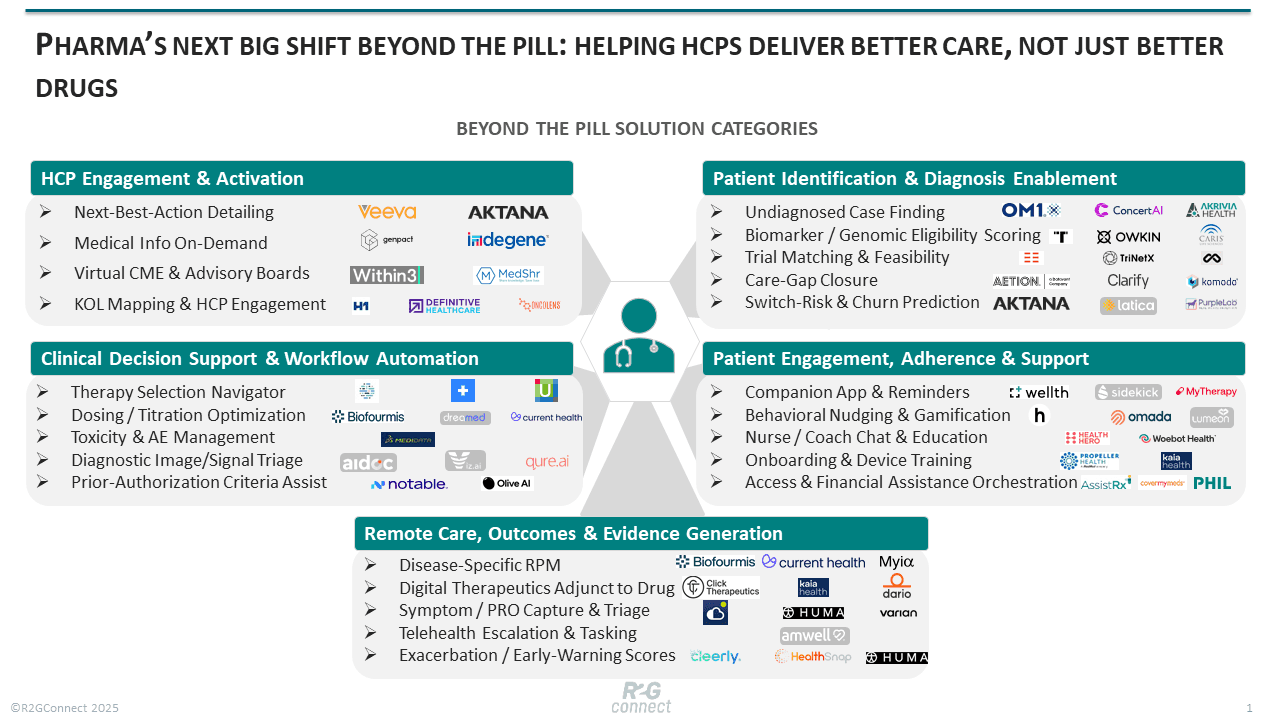
Below are five key BtP categories where pharma is empowering HCPs through technology, data, and AI.
1. HCP Engagement & Activation
Pharma’s first wave of digital transformation focused on omnichannel engagement, but BtP takes it further by using AI to make every touchpoint smarter and more personalized.
Solutions like Next-Best-Action (NBA) platforms leverage predictive analytics and machine learning to recommend the right message, timing, and channel for each HCP, helping field teams tailor outreach efficiently. Examples include Aktana and Veeva Crossix, which are already driving omnichannel optimization across major pharma portfolios.
Medical information chatbots, powered by NLP and large language models (LLMs), deliver compliant, on-demand answers to drug queries, reducing the burden on MSLs while ensuring instant responses. Companies such as Genpact Cora and Indegene have deployed these solutions to streamline HCP support.
At the same time, virtual CME and advisory board platforms like Within3 and MedShr enable pharma to educate and engage HCPs at scale, while KOL mapping systems from H1, Monocl, or OncoLens use data and network analytics to identify and connect scientific leaders.
For HCPs, these tools simplify communication and learning; for pharma, they translate into stronger engagement, faster response times, and deeper insights into prescriber needs.
Strategic value: Optimized HCP engagement and stronger scientific advocacy networks. Integration readiness: High. Most tools integrate directly with CRM systems such as Veeva and Salesforce.
2. Patient Identification & Diagnosis Enablement
BtP solutions in this area help HCPs find the right patients faster, supporting earlier diagnosis, targeted therapy decisions, and access to research opportunities.
AI-driven platforms such as undiagnosed case-finding tools analyze EHR and claims data to surface patients who may qualify for specific treatments but remain unrecognized, enabling physicians to intervene sooner. Companies like OM1, ConcertAI, and Akrivia Health provide such tools that seamlessly fit into clinical workflows.
Biomarker and genomic eligibility scoring solutions, including those from Tempus, Caris Life Sciences, and Owkin, assist clinicians in identifying patients whose molecular profiles align with targeted therapies, making precision medicine easier to implement.
Similarly, trial-matching platforms such as Deep 6 AI, TriNetX, and Mendel.ai automatically align patient data with study inclusion criteria, helping HCPs refer eligible patients efficiently. Care-gap closure analytics, developed by Aetion, Clarify Health, and Komodo Health, highlight missed screenings or therapy opportunities, allowing clinicians to improve adherence to guidelines. For clinicians, these technologies mean faster insights and fewer manual steps; for pharma, they expand patient reach and improve therapy precision.
Strategic value: Earlier diagnosis, improved targeting, and enhanced R&D collaboration. Integration readiness: High. Works with EHR, claims, and genomic data systems.
3. Clinical Decision Support & Workflow Automation
In clinical practice, time and accuracy are everything. BtP solutions help HCPs make faster, safer treatment choices while reducing repetitive documentation and approval bottlenecks.
Therapy selection navigators such as Ada Health, Infermedica, and UpToDate+ combine real-world evidence, clinical guidelines, and patient-specific factors to recommend optimal treatments, acting as intelligent copilots for physicians.
Dosing and titration optimization tools, including Biofourmis, DreaMed, and Current Health, use predictive analytics to suggest safe dose adjustments over time, improving precision and reducing risk.
Meanwhile, toxicity and adverse-event management systems like Medidata Detect analyze patient data to guide clinicians through evidence-based interventions, enhancing safety. Prior-authorization automation solutions from Olive AI and Notable Health streamline reimbursement submissions, helping clinics reduce administrative time and speed up therapy initiation.
These platforms give clinicians more time for patient care and fewer forms to fill out — a win for both HCPs and patients.
Strategic value: Streamlined workflows and safer, data-driven clinical decision-making. Integration readiness: Moderate to high. Integrates with CDS, EHR, and payer systems.
4. Patient Engagement, Adherence & Support
Between visits, patients often struggle to stay on track. BtP solutions bridge that gap by helping HCPs monitor adherence, deliver personalized education, and sustain therapy success without increasing their workload.
Digital companion apps such as Wellth, Sidekick Health, and MyTherapy send tailored medication reminders, track progress, and provide adherence insights that clinicians can view during check-ups. Behavioral nudging and gamification platforms from Happify Health (Twill), Omada, and Lumeon sustain patient motivation through rewards and progress tracking, reinforcing HCP guidance in daily life.
AI-powered chat and coaching tools, including HealthHero and Woebot, extend clinical communication by offering multilingual education and mental-health support, freeing HCPs from routine follow-ups. Access and financial automation platforms such as AssistRx, PhilRx, and CoverMyMeds further reduce administrative pressure on clinics by automating co-pay verification and patient assistance workflows.
For HCPs, these tools mean better adherence visibility and less manual coordination; for patients, they deliver consistent, ongoing support that sustains therapeutic success.
Strategic value: Simplifies patient management and strengthens long-term adherence. Integration readiness: High. Connects with CRM, PSP, and payer systems.
5. Remote Care, Outcomes & Evidence Generation
BtP’s most advanced layer brings the clinic closer to the patient, giving HCPs continuous visibility into therapy outcomes and enabling proactive care.
Remote patient monitoring (RPM) platforms such as Biofourmis, Current Health, and Myia continuously track vital signs and symptoms, alerting clinicians to early signs of deterioration. Digital therapeutics (DTx) like Click Therapeutics, Kaia Health, and Happify Health (Twill) act as adjuncts to treatment, providing behavioral interventions while sending progress data back to care teams.
At the same time, symptom and patient-reported outcome (PRO) capture tools from Patient Cloud, Huma, and Noona (Varian) collect structured feedback that helps HCPs assess therapy effectiveness between visits. Early-warning algorithms, developed by Cleerly, HealthSnap, and Huma, detect exacerbations and alert clinicians before complications arise.
For clinicians, these systems shift monitoring from reactive to proactive, improving clinical efficiency and patient safety. For pharma, they generate real-world evidence that proves the long-term value of therapies in everyday care.
Strategic value: Enables proactive care and continuous clinical insight generation. Integration readiness: High. Compatible with RPM, EHR, and analytics systems.
AI: The Engine Behind BtP
Artificial intelligence connects every BtP solution. From predictive analytics that forecast adherence and risk to NLP that structures medical text or behavioral AI that adapts engagement, these technologies convert data into clinical insight. For HCPs, AI means more time with patients and fewer repetitive tasks; for pharma, it ensures every digital service delivers measurable, evidence-based value.
Evidence, Integration, and Partner Fit
The success of a BtP solution depends on two critical maturity dimensions: (1) Evidence level — whether the solution has peer-reviewed validation, regulatory clearance, or scaled commercial pilots; and (2) Integration flexibility — the ability to connect seamlessly with CRM, EHR, RPM, or payer ecosystems. High-evidence, high-integration solutions represent the “sweet spot” for partnership. These are the vendors capable of scaling globally while aligning with pharma’s data security and compliance standards.
The New R2GConnect Pharma Channel Imperative: Partner, Don’t Build
Pharma does not need to build every BtP solution internally. The innovation already exists among HealthTech startups, validated and ready for integration into care and commercial workflows. By partnering with these innovators, pharma can accelerate adoption, reduce costs, and empower clinicians where it matters most — in daily patient care.
💡 Apply to the active R2GConnect Pharma Channel: Digital Tools for Pharma to Engage HCPs and Clinics Beyond the Pill This open call connects pharma, MedTech, and HealthTech innovators to co-create BtP solutions that make clinicians’ work easier, enhance patient support, and generate actionable real-world insights. Selected participants gain visibility among global pharma decision-makers and receive direct invitations for partnership discussions.
🕒 Deadline: December 31, 2025 | 🌐 Apply now via R2GConnect