A Market Too Big to Ignore The United States remains by far the largest and most dynamic market for digital health.
According to IMARC Group, the U.S. digital health market reached $160.4 billion in 2024 and is projected to climb toward $695.2 billion by 2033, reflecting a robust compound annual growth rate[1]. This outsized expansion is driven by a combination of factors: high healthcare spending, a culture of innovation, and the rapid adoption of technologies such as telehealth, medical wearables and healthcare analytics. Investor appetite remains strong, with billions of dollars still flowing into U.S. digital health startups.
On the demand side, digital health usage continues to rise; more than half of Americans have had a telehealth visit, underscoring that virtual care has become mainstream[2]. Taken together, the scale and momentum of spending and adoption make the U.S. an unparalleled opportunity for healthtech innovators.
Why Global Founders Look to the U.S. For startups in Europe, Asia and other regions, the U.S. remains the ultimate proving ground. It combines a large addressable market with a willingness to pay for innovation, and its fragmented payer mix—from private insurers to Medicare and Medicaid—creates multiple channels for revenue.
Telehealth is now mainstream, and the proliferation of corporate venture funds and dedicated digital health investors means there is substantial capital available to scale promising solutions. Early‑stage rounds remain common, giving young firms a clear pathway to grow. Likewise, AI‑enabled healthtech solutions are especially coveted as providers look to automate workflows and personalize care.
These dynamics explain why global founders aim to make it in America: success here often serves as validation for international expansion and can dramatically increase company valuations.
Where Startups Struggle Yet the same factors that make the U.S. attractive also make it challenging. Unlike many countries with centralized health systems, the U.S. healthcare landscape is a fragmented “market of markets” with its own rules, norms and gatekeepers.
According to the HealthTech Startup Needs Report, healthtech companies on R2GConnect illustrate where they need the most help.
In an analysis of 8,600+ healthtech startups registered on the platform, the most requested service is investor search and fundraising (60%-66% percent), but many other needs reflect the complexity of U.S. entry.
Crucially, 16 percent of the rest of the world’s (RoW) startups ask for market access support to navigate reimbursement models, pricing and distribution. Regulatory and compliance concerns are also prominent: 14 - 17 percent request regulatory advice to navigate HIPAA and FDA requirements, get compliance advice, or seek support for reimbursement pathways such as DIGA or PECAN. These figures underscore that non‑U.S. startups grapple with more than capital; the real hurdles involve understanding local regulations, securing the right reimbursement codes and convincing cautious buyers.
Compounding the challenge, sales cycles in the U.S. are long and relationship‑driven. Health systems and insurers often require pilot studies, U.S.‑based clinical data and multistakeholder buy‑in before signing contracts. Without a focused strategy and local partners, international startups risk burning through resources without clear traction.
Common Pitfalls to Avoid Many promising innovations stumble in America because they underestimate the differences. Four pitfalls are especially common:
- Mispricing or misunderstanding reimbursement. Setting a price without mapping out CPT or HCPCS codes and payer coverage can leave a product unfundable. Some founders assume their home‑country pricing will translate; it rarely does.
- Going too broad, too soon. Trying to simultaneously sell to hospitals, insurers, employers and patients is a recipe for dilution. The U.S. market rewards focus; start with a beachhead segment and expand once you have proof.
- Underestimating time‑to‑revenue. Closing a hospital or health‑plan deal can take 12–18 months. Without sufficient runway or a plan for pilot revenue, companies may run out of cash.
- Lack of local validation. Payers and providers want to see U.S.‑specific data and user feedback. Launching without local pilots or clinical studies makes adoption far more difficult.
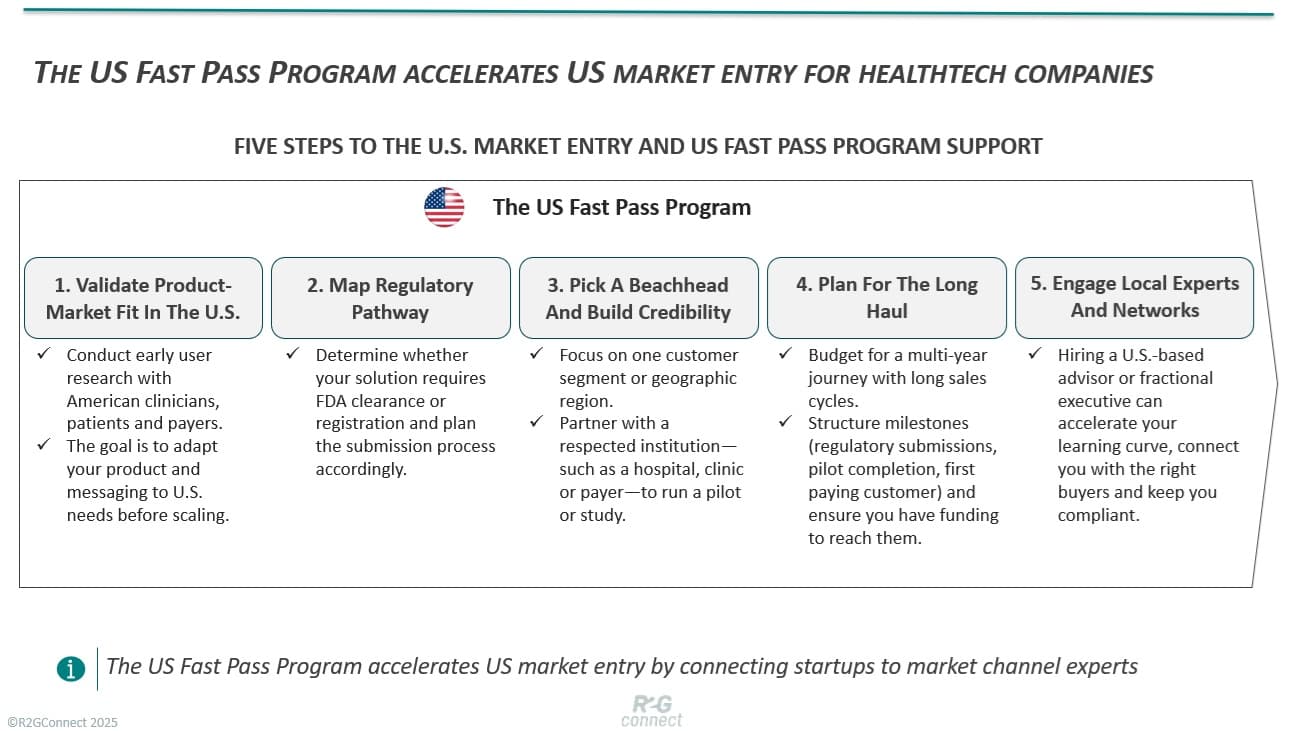
Five Steps to Crack the U.S. Market Despite these obstacles, hundreds of foreign companies have succeeded by taking a structured approach. Based on expert interviews and the experiences of R2GConnect startups, five best practices stand out:
1. Validate product–market fit in the U.S. Conduct early user research with American clinicians, patients and payers. This can be as simple as customer interviews or as involved as a small clinical pilot. The goal is to adapt your product and messaging to U.S. needs before scaling. 2. Map your regulatory and reimbursement pathway. Determine whether your solution requires FDA clearance or registration and plan the submission process accordingly. Simultaneously, assess how you will be paid: Which CPT or HCPCS codes apply? Will insurers cover your service, or will you launch cash‑pay/direct‑to‑consumer? Seek specialist advice. 3. Pick a beachhead and build credibility. Focus on one customer segment or geographic region. Partner with a respected institution—such as a hospital, clinic or payer—to run a pilot or study. This not only generates data, but also provides a marquee reference to open doors elsewhere. 4. Plan for the long haul. Budget for a multi‑year journey with long sales cycles. Structure milestones (regulatory submissions, pilot completion, first paying customer) and ensure you have funding to reach them. Recognize that U.S. salaries, marketing and compliance costs are higher than in many other markets. 5. Engage local experts and networks. Hiring a U.S.‑based advisor or fractional executive can accelerate your learning curve, connect you with the right buyers and keep you compliant. Market access specialists, regulatory consultants and experienced sales leaders are worth the investment.
Getting Expert Guidance: The US Fast Pass Program Executing these steps alone can be daunting. That’s why R2GConnect, in collaboration with New Enterprise Ventures (NEV), created the US Fast Pass Program to give high‑potential healthtech companies a structured pathway into the U.S. market. The program consists of three phases:
Phase 1, Market Validation, offers a free session with U.S. healthcare executives who review your pricing, reimbursement and regulatory strategy. Founders receive candid feedback on their current plans and learn how U.S. buyers evaluate new solutions.
Phase 2, Strategy Optimization, pairs selected participants with subject matter experts to refine their go‑to‑market plan. Whether you need deeper guidance on FDA pathways, payer segmentation or sales channels, these workshops provide tailored recommendations at no cost.
Phase 3, Turnkey Commercialization, is an optional engagement in which NEV’s executive team and fractional leaders help execute the U.S. launch. Depending on mutual interest, this can include investment, board participation or sales support, giving startups the relationships and expertise to accelerate growth.
Find out more about the U.S. Fast Pass market entry acceleration program and apply today. Learn more about the program and submit your application here
References [1] United States Digital Health Market Size, Share, 2025-2033