
The success of a medical app depends on usage, but most apps fall short. Without active users, neither patients nor publishers gain value. Studies show that over 80% of medical and wellness apps are downloaded fewer than 5,000 times, with only a few dozen or hundreds of monthly active users. Only niche business models, such as in pharma or hospitals, can sustain themselves on such small user bases while all others struggle.
Why usage remains low Low adoption and engagement can stem from business or concept issues such as weak product–market fit, overly narrow target groups, or pricing and service barriers, as well as technical implementation flaws, for example:
- Design that fails to connect with target users
- Complicated signup processes leading to high dropout rates
- Lack of features that support daily use
- Limited user communication or notifications
- Poor integration into clinical workflows
What to do about it To increase downloads, usage, and retention, medical app developers need proven technical and strategic approaches. The challenge is not just building an app, but ensuring it becomes a relevant, engaging, and sustainable solution in everyday healthcare.
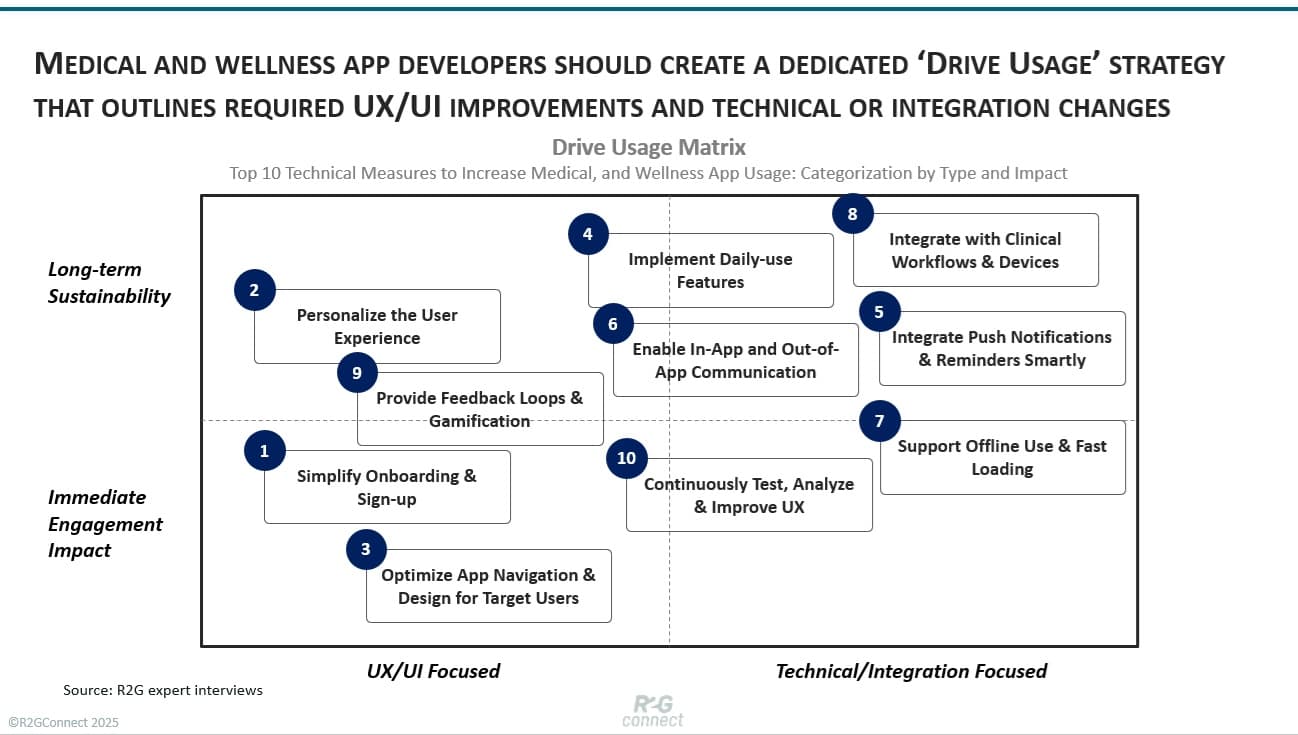
There is no one-size-fits-all solution, but app developers can leverage proven tactics to increase usage of their apps. Each developer should create and regularly update their own ‘Drive Usage’ matrix. The following are the top 10 recommendations from medical app development specialists to get started.
Top 10 Recommendations for Higher Usage & Retention
1. Simplify Onboarding & Sign-up
- Minimize required steps and allow social login, biometrics, or single sign-on.
- Example: Instead of a 10-field registration form, enable “Sign up with Apple/Google” to reduce drop-offs (as highlighted in the article: cumbersome sign-up = high dropout).
2. Personalize the User Experience
- Tailor dashboards, content, and reminders to user profiles and health goals.
- Example: A diabetes app shows glucose trends first, while a fitness app highlights step counts.
3. Optimize App Navigation & Design for Target Users
- Use clear icons, simple menus, and an accessible design (large fonts, contrast).
- Example: Older patient groups benefit from larger buttons and voice prompts, improving adoption (ref. article: design not appealing to target group).
4. Implement Daily-use Features
- Embed small, recurring tasks (journaling, symptom check-ins, progress tracking).
- Example: A mental health app with a daily mood tracker keeps users returning.
5. Integrate Push Notifications & Reminders Smartly
- Provide value-driven, personalized nudges instead of generic alerts.
- Example: “Don’t forget your blood pressure reading today” works better than “Open the app!”
6. Enable In-App and Out-of-App Communication
- Offer secure messaging with care teams or automated chatbot check-ins.
- _ Example_: A physiotherapy app sends a weekly progress report by email and push notification to keep patients engaged.
7. Support Offline Use & Fast Loading
- Allow core features (like exercise routines or symptom logging) without full connectivity.
- Example: A fitness app lets users log workouts offline and sync later, reducing frustration.
8. Integrate with Clinical Workflows & Devices
- Connect with EHRs, wearables, or medical devices to make the app part of daily care routines.
- Example: A cardiac rehab app automatically uploads step counts from a smartwatch, reducing manual input (ref. article: lack of workflow integration).
9. Provide Feedback Loops & Gamification
- Reward users with progress charts, milestones, or badges.
- Example: A smoking cessation app shows “10 days smoke-free” streaks and progress vs. peers.
10. Continuously Test, Analyze & Improve UX
- Use A/B testing, heatmaps, and user surveys to refine design and functionality.
- Example: Testing two different reminder wordings to see which yields higher adherence.
There are many ways to improve usage and retention of a medical or wellness app, but the right tactics depend on each individual solution.
To identify what works best for your app, Bornholdt Lee offers two free assessments on R2Gconnect:
Free Medical App Usage Assessment – Discover How to Boost Adoption and Engagement. Deadline: 17.9 => Understand usage barriers and get actionable recommendations to increase adoption and retention.
Free Technical Assessment: Rebuild, Edit or Sell your Medical App Deadline: 17.9 => Clarify whether it makes more sense to enhance your existing app, rebuild it from scratch, or prepare it for sale.
Both deals provide expert guidance to help HealthTech companies make informed decisions and strengthen their market position.