
A predictable gap in an otherwise capable team
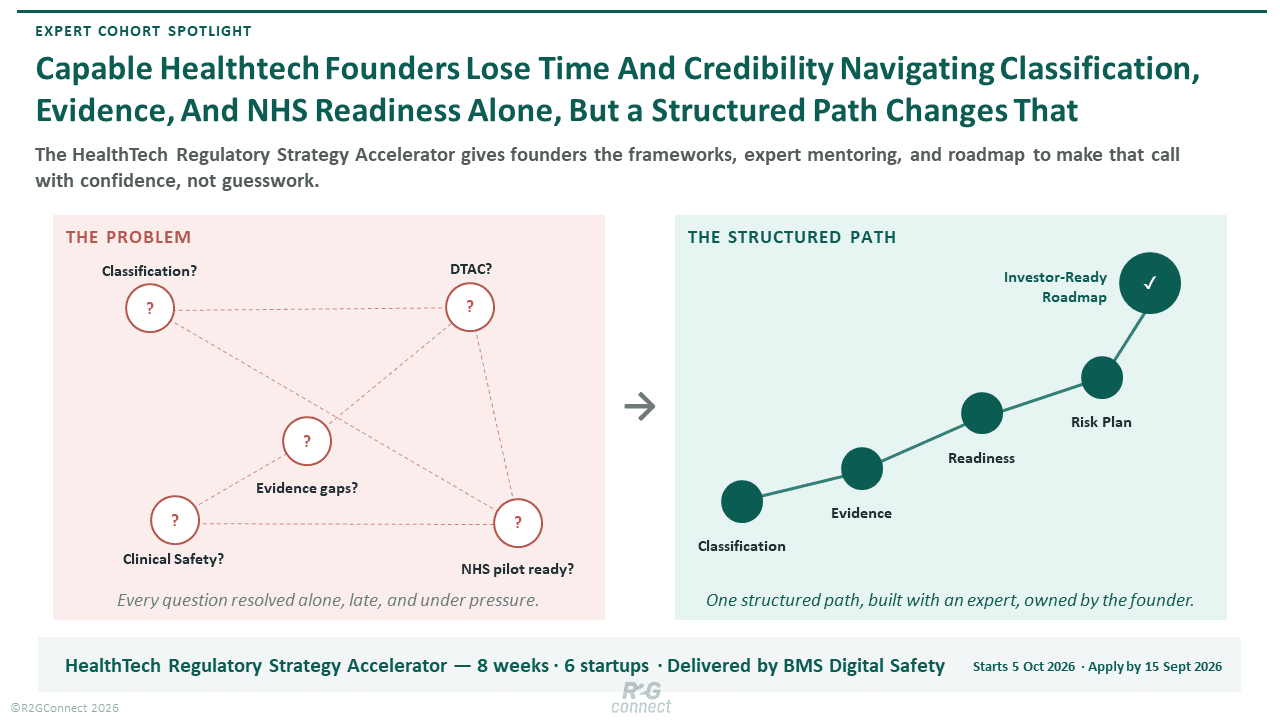
Across early-stage HealthTech companies, one pattern recurs with striking consistency: regulatory strategy is the last major workstream to receive a founder’s deliberate attention, and the first one to be tested under external pressure. An investor asks for a regulatory pathway. A hospital pilot requires a classification position. An NHS procurement process expects evidence of Clinical Safety and DTAC readiness. The question, in one form or another, is always the same — what actually needs to be regulated here, and how? — and it typically surfaces well after product decisions that depend on the answer have already been made.
This is not a symptom of weak planning. It reflects a genuine mismatch between the skills required to build a health product and the skills required to classify and clear one. Clinical insight, engineering depth, and market instinct are the capabilities that get a product built; regulatory literacy is a distinct discipline that most founding teams have had no structured reason to acquire before it is suddenly required of them. The transition from product-builder to regulatory decision-maker is a genuinely difficult one — capable founders go through it, not just underprepared ones.
Left unaddressed, the pattern is consistent across companies: product features are built before classification is confirmed, evidence and cybersecurity requirements surface late — usually during procurement rather than at the design stage — and investor confidence weakens when the regulatory answer changes depending on who in the company is asked. Engineering time is then spent partially undoing work once the true pathway becomes clear. None of this shows up in a product demo; it shows up months later, in a diligence process or a stalled deal.
Why the existing options don’t close the gap
When founders do look for support, the available options tend to solve a narrower problem than the one they actually have:
- Specialist regulatory consultancies go deep on a specific product, but a full strategy and roadmap engagement typically runs around £20,000 - £50,000 as a standalone deliverable — and the founder is often left holding a document rather than the reasoning and judgment behind it, which makes it hard to adapt as the product changes.
- Generic guidance and public frameworks are freely available, but built for no product in particular. The details that actually determine a company’s pathway — intended use, classification, target markets — are exactly what generic material cannot tell them.
Neither model is designed to build lasting capability. One transfers an answer; the other transfers nothing specific enough to act on. Founders are left needing to re-solve the same problem, largely from scratch, every time their product, market, or evidence base moves — which, for an early-stage company, is often and continuously.
A structured alternative: building the capability, not just the document
This is the gap R2GConnect’s newest Expert Cohort is built to close. The HealthTech Regulatory Strategy Accelerator, delivered by BMS Digital Safety, is an 8-week programme for early-stage and scaling HealthTech, MedTech, and AI healthcare companies navigating medical device regulation for the first time. Across four expert-led workshops and three personalised mentoring sessions, founders build their own UK, EU, and/or US regulatory strategy and roadmap — covering classification and pathway, clinical evidence and validation, and Clinical Safety and DTAC readiness — rather than receiving one produced on their behalf.
The distinction is deliberate. As BMS Digital Safety frames its own approach: the aim is not to tell founders what to do, but to teach them how to understand regulatory requirements, make informed decisions, and build a regulatory strategy they can maintain themselves as the business grows. No prior regulatory experience is required — the programme is built for founders encountering this discipline for the first time, not for teams that have already fallen behind.
The cohort is led by Tom Bradshaw, a practising GP and Accredited Clinical Safety Officer with over 16 years of NHS experience, alongside Brett Marshall at BMS Digital Safety. The economics reinforce the model’s intent: participants leave with a strategy and roadmap typically valued at around £8,000 as a standalone consultancy engagement, built through the cohort at roughly an 80% saving — alongside the reusable frameworks and confidence to keep evolving it independently.
Who the programme is built for
The Accelerator is a reasonable fit for a founder or leadership team if:
- The product already touches, or is close to touching, real patients, clinicians, or care pathways, and no one on the team has mapped the regulatory pathway yet.
- A fundraising round, hospital pilot, or NHS conversation is approaching, and the company needs a credible regulatory position rather than a placeholder slide.
- Regulatory advice received so far has been inconsistent, or absent, and the team wants to understand the reasoning — not just receive an answer.
- The preference is to build the regulatory roadmap deliberately, over eight structured weeks, rather than discover the gaps later, during due diligence.
The details:
- Duration: 8 weeks · Cohort size: 6 startups
- Start date: 5 October 2026 · Apply before: 15 September 2026
- Investment: from £1,995 (excluding taxes), with a further £500 discount for the first three registered startups
Interested startups are first invited to a complimentary 30-minute Regulatory Discovery Call with BMS Digital Safety, to review the product, discuss current regulatory challenges, and confirm fit before any commitment is made.
The regulatory questions won’t stop arriving as the product matures — they compound with every new feature, market, and evidence requirement. The value of this cohort is less in the document it produces than in ensuring founders aren’t re-deriving the answer alone, from first principles, every time the question resurfaces.