
What Are DiPA and Why Do They Matter Now? (DiPA vs. DiGA) Digitale Pflegeanwendungen (DiPA) are digital care applications; software designed to support people with long-term care needs in daily life. Introduced by the 2021 Digital Care and Nursing Modernization Act (DVPMG), DiPA extends Germany’s pioneering “apps on prescription” model into the care sector. In contrast, **DiGA (Digitale Gesundheitsanwendungen) **are digital health applications reimbursed under health insurance for medical conditions.
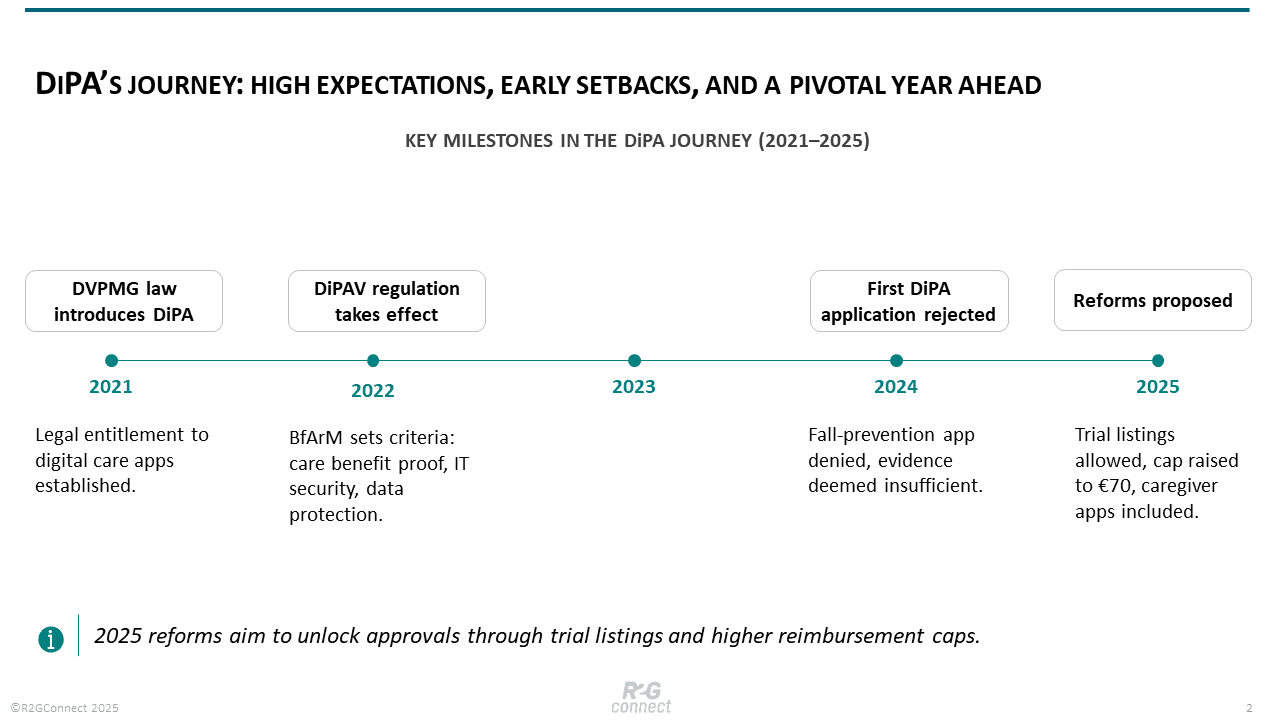
**Why it matters now: **Germany’s population is aging, and since 2022, people with care needs have been legally entitled to DiPA reimbursement through care insurance. Yet due to high evidence and security requirements, no DiPA had been approved by 2025. Regulators are now adjusting the program to encourage innovation, including proposals to allow trial listings (similar to DiGA), increase reimbursement caps, and expand eligibility to caregiver-focused apps. This makes 2025 a turning point for startups.
Categories of Digital Care Solutions Eligible for DiPA Not every elder-care app qualifies as a DiPA. The app’s primary purpose must be to support daily care and independence of the person in need of care, or their caregivers.
Eligible categories include:
- Everyday independence support: mobility training, fall prevention, or cognitive exercises for dementia patients.
- Care organization & coordination: medication reminders, task scheduling, caregiver-family coordination tools.
- Special care situations: dementia support tools, fall-risk assessment and training apps.
- Caregiver-focused applications: platforms that guide or relieve relatives and informal carers (e.g., stress management, education, proper transfer techniques). Not eligible: apps limited to wellness, lifestyle, administrative functions, or pure information services. A DiPA must demonstrate a direct care-related benefit.
The DiPA Application & Regulatory Process (BfArM and DiPAV) The Federal Institute for Drugs and Medical Devices (BfArM) manages DiPA approvals, based on the** DiPAV ordinance** (2022).
Key requirements:
- BfArM fast-track review: Application must include documentation showing compliance with safety, quality, data protection, and IT security standards.
- Evidence of care effect: A quantitative study comparing outcomes with and without the app. For example, proving reduced falls or caregiver stress. Unlike DiGA, evidence must be presented upfront (though trial listing proposals may change this).
- Data protection & security: Apps must meet strict requirements, often requiring external penetration testing, ISMS implementation, and audits. Independent certification is expected to become mandatory.
- Usability & accessibility: Apps must be barrier-free and designed for older adults. If the app is also a medical device, CE-marking and QMS compliance apply.
Current Status of the DiPA Directory (2025) As of early 2025, no DiPA has been approved for reimbursement. The first submission, a fall-prevention app, was rejected in 2024 for insufficient evidence. Several others are in the pipeline, focusing on mobility, dementia, and caregiver coaching.
Regulatory adjustments underway: Germany’s proposed Pflege-Kompetenzgesetz aims to:
- Allow a one-year provisional listing to gather evidence.
- Raise the monthly reimbursement cap from €53 to €70.
- Expand eligibility to caregiver-focused apps. These changes could make 2025 the year of the first DiPA approvals.
Opportunities and Challenges for Startups Opportunities:
- Untapped market: Over 5 million people receive care benefits in Germany. DiPA could open recurring revenue streams through reimbursement.
- Regulatory tailwinds: Political support is strong, and barriers are being lowered to support adoption.
- First-mover advantage: Early entrants can define standards and secure partnerships with care insurers and caregiver networks.
Challenges:
- High compliance burden: Meeting evidence, security, and quality standards is resource-intensive.
- Complex outcomes: Measuring “care benefit” is often harder to proof than medical outcomes.
- Adoption hurdles: Users or caregivers must apply themselves; outreach and education are essential.
- Economic constraints: A capped reimbursement model requires careful business planning.
R2GConnect Deal For startups preparing to apply there is a Deal on R2GConnect from TÜV Informationstechnik GmbH (TÜVIT), a leading IT security and certification body, offering a free 60-minute “DiPA compliance” consultation for developers and manufacturers on R2GConnect.
Deadline: 3.10.2025! To find out more and to apply click here
The DiPA program is still in its infancy, but it represents one of the most promising opportunities for HealthTech founders in 2025. With no apps listed yet, the field is wide open for innovative caregiving solutions. Regulatory reforms are making the pathway more accessible, and reimbursement creates a stable route to scale. For startups ready to tackle compliance and evidence challenges, DiPA could be the next frontier in digital health.