
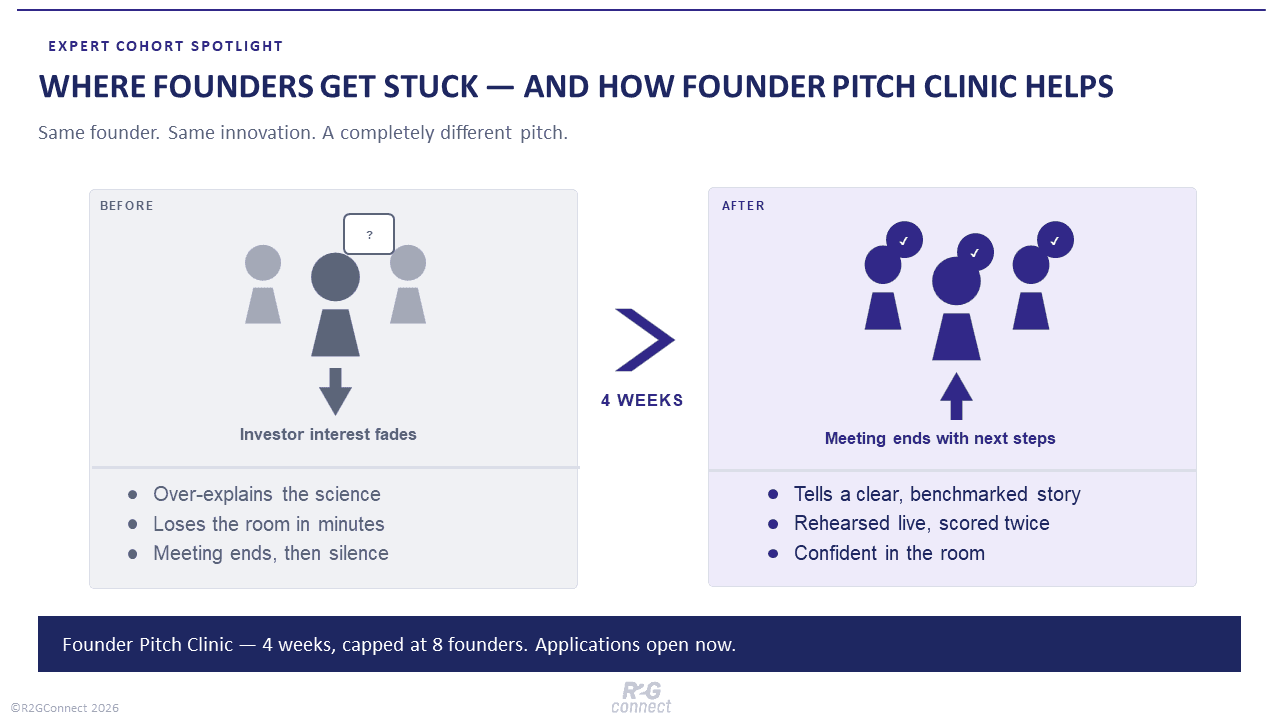
HealthTech founders spend years developing their product, generating clinical evidence, and building the team to bring it to market. Then they get 15 minutes in front of an investor, a hospital, or a strategic partner — and the meeting ends with "interesting, let's stay in touch," followed by silence. It's a familiar pattern, and it's rarely about the innovation itself. More often, it's about how the story around it gets told.
Decision-makers don't have the time, or usually the technical background, to work through a complicated presentation. Within the first few minutes, they've decided whether they understand the problem, believe the solution is relevant, and want to keep talking. Miss that window, and even a strong innovation can quietly drop off the shortlist.
Every important opportunity starts with a pitch
Whether you're raising a round, selling into a hospital system, applying to an accelerator, or responding to an innovation challenge, the process almost always opens with a short presentation. The founders who consistently get the follow-up meeting aren't necessarily the ones with the most sophisticated technology — they're the ones who can clearly answer: 1. why the problem matters now, 2. why their solution is different, 3. why their team is the right one to solve it, 4. and why the person in front of them should care.
Get those four questions across clearly, and the odds of a follow-up meeting, a pilot, or a term sheet go up considerably. Miss them, and the strongest technology in the room can still walk away empty-handed.
Why so many founders struggle with this
HealthTech founders are trained in medicine, science, and engineering — not storytelling. That shows up in the pitch: decks get feature-heavy and technically dense, and founders try to explain everything instead of the two or three things that actually matter to the person listening.
It also shows up as feedback that contradicts itself from one advisor to the next: "Add more technical detail." "Simplify your message." "Your deck looks great." "I still don't understand why this matters."
None of that is wrong, exactly — it just leaves founders with no clear direction on what to fix first.
A pitch consultant can cut through that, but personalised 1:1 coaching is usually priced out of reach for an early-stage company. Templates and online courses sit at the other end — affordable, but generic, with no expert feedback and no room to practice out loud. Between the two, there's not much in the middle.
That's what Expert Cohorts are built to close
This challenge is exactly why R2GConnect introduced Expert Cohorts.
Expert Cohorts give startups access to highly specialised experts through small, structured group programmes. Instead of paying for expensive one-to-one consulting, founders learn directly from recognised specialists while working alongside a small group of peers facing similar challenges.
The objective is simple: make specialist expertise accessible to many more startups without compromising quality.
Each cohort focuses on solving one specific business challenge—from regulatory strategy and AI validation to leadership development or investor communication.
Rather than broad accelerator programmes, Expert Cohorts are designed around practical outcomes that founders can immediately apply to their business.
Founder Pitch Clinic: from confusing to compelling
One of the first Expert Cohorts live on R2GConnect tackles this exact problem. Founder Pitch Clinic, led by strategic storytelling expert Meenakshi Baruah of Untangling Labs, helps founders turn a technical, over-explained presentation into a clear, compelling business story.
Over four weeks, founders rework their narrative, slide structure, and delivery through expert coaching, peer review, and repeated live practice: The point isn't a better-looking deck — it's a meaningfully higher chance that the next investor meeting, customer presentation, or pitch competition actually converts.
The group is the point, not just the price
Founders don't only get expert feedback on their own pitch — they watch seven other founders work through the same kind of presentation, live. Seeing where someone else's pitch lands, or doesn't, tends to surface blind spots in your own that are hard to catch alone. That combination of expert guidance, peer benchmarking, and repeated practice is difficult to replicate in a 1:1 engagement, at any price.
Democratizing access to specialist expertise
For many startups, specialist consulting has always been a luxury.
Expert Cohorts are changing that.
By bringing together small groups of founders with leading experts, R2GConnect makes high-value expertise available for a fraction of the cost of traditional consulting engagements.
The goal is not simply to improve one presentation.
It's to help more HealthTech innovators communicate with confidence, compete more effectively for funding and partnerships, and ultimately accelerate the adoption of innovations that deserve to reach patients.
As more Expert Cohorts launch across topics such as regulatory strategy, AI validation, commercialisation and leadership, R2GConnect is building a practical learning ecosystem where startups can access exactly the expertise they need—when they need it.
Learn more
The Founder Pitch Clinic — From Confusing to Compelling Clinic begins on 15 September 2026 and is intentionally limited to a small group of founders to maximise expert interaction and peer learning.
Early Bird applications close on 15 August 2026, after which the standard programme fee applies.
You can learn more about the Founder Pitch Clinic and submit your application on R2GConnect. You can also explore the growing portfolio of Expert Cohorts designed to help HealthTech startups solve their most critical business challenges through affordable, expert-led group programmes.