
The pattern
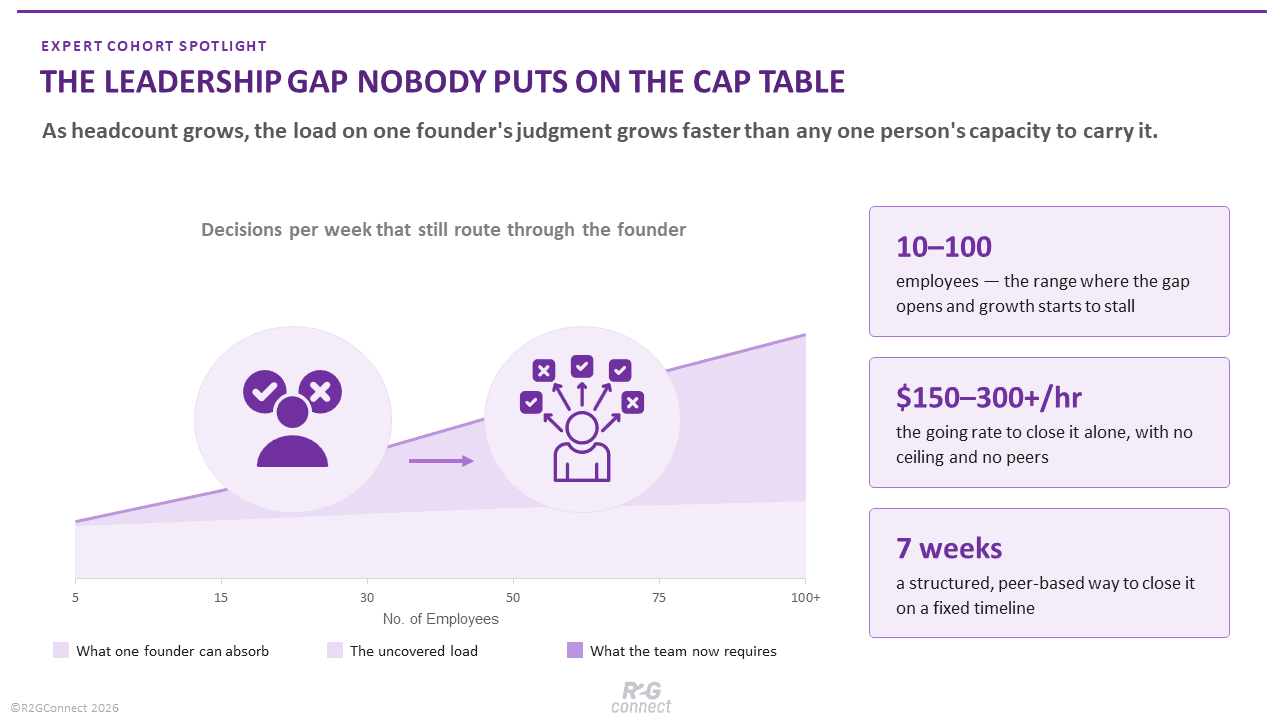
Health startups tend to move through their leadership transition quietly, and the strain of it rarely shows up where anyone's looking. Revenue is fine. The product works. Clinical validation is holding up. And yet, somewhere in the range of 10 to 40 employees, growth starts to slow in a way that doesn't show up in any dashboard a board would ask to see.
The cause is rarely competitive or technical. It's structural: the operating model that took the company from zero to ten people — one person weighing in on most decisions — simply wasn't built to run at forty. That's not a verdict on the founder; it's a mismatch between an operating model and a headcount, and it's close to universal. It shows up first as a private, practical set of questions — the kind that never make it into a board deck, because there's no metric for them.
“Why does everything still route through me, and which of those decisions should move?” “Am I delegating, or just handing off tasks without the support behind them?” “Is this disagreement healthy, or is my team quietly avoiding it?” “How do I sound steady when I genuinely don't know the answer yet?”
Investors ask about traction. They rarely ask whether the CEO trusts the VP of Ops. But talk to a founder six months into a serious growth spurt, and it's usually the second question keeping them up.
Why capable leaders go through this
The skills that get a health startup off the ground — deep clinical or technical fluency, the willingness to do the work yourself, sheer hustle — are simply different from the skills that keep it growing. Being the best individual contributor in the building is a different job from building the team that no longer needs you to be. Almost nobody is trained for that handoff; it isn't taught alongside the clinical or technical expertise that got the company this far. It arrives, uninvited, somewhere in the 10-to-100-employee range, on top of everything else a founder is already carrying.
Left unaddressed, the pattern is consistent enough to be almost predictable: — Delegation tends to swing between two extremes — total hand-off with no support, or total control with no trust. Both can look like delegation from the outside, while the founder is still carrying most of the weight underneath. — Disagreement goes underground. Teams stop surfacing conflict in the room and start managing it in side channels, which is slower and more expensive than the disagreement itself. — Leadership development gets misclassified as a founder-only problem, which quietly excludes the co-founders and emerging managers who are often closest to where the strain actually is.
None of this means these leaders are getting something wrong. It reflects a genuinely hard transition that nobody scheduled time for — and one that most leaders are simply working through as they go.
Why the existing options don't fit
When leaders do go looking for help, the market mostly offers two options, and neither is sized correctly for this specific problem.
A traditional accelerator covers the whole business, not just this one gap. It typically runs 3 to 6 months and asks for equity or a five-figure fee, and while there's often some peer exposure built in, it's incidental rather than designed. That's a lot of scope, time, and cost for one specific, personal transition.
1:1 executive consulting goes the other way: it goes deep on exactly the founder's problem, with real personalization. But it's open-ended, runs $150–300 or more an hour with no natural ceiling, and the leader works through it alone — there's no peer working through the same thing alongside them.
An accelerator asks a founder to freeze the business for two quarters to fix one thing. A consultant solves the right problem but leaves the leader working through it alone, at a price that discourages the ongoing use most transitions actually need. Neither is designed for someone who needs focused, practical support on this specific shift — from doing the work to leading the people who do it — without either outcome.
A third model: structured, time-boxed, peer-based
That gap is what R2GConnect's newest Expert Cohort, delivered by Beandgo, is built to close.
From an Expert to the Leader Your Startup Needs Next is a seven-week program for founders, co-founders, and emerging leaders at health startups currently living through this transition. It's deliberately narrow in scope: rather than covering leadership broadly, it isolates the one shift — from expert to team-builder — and works through it week by week.
The structure pairs two formats that are usually sold separately: — A shared cohort workshop each week, where participants apply leadership concepts to a live decision or team conflict happening in their own startup that week — not leadership theory in the abstract. — An individual Leadership Session, running in parallel, that tailors the material to that person's actual team and situation.
Participants leave with a personalized Leadership Toolkit — including an Authentic Leadership Canvas, a Delegation & Trust Playbook, a Team Alignment Charter, and five additional frameworks — plus a completed Leadership Logbook documenting their own experiments, and a Leadership Action Plan to sustain the work after week seven ends.
Why the format itself is the point
The cohort model earns its place here precisely because it borrows the strongest element of each existing option while dropping the parts that don't fit the problem. Eight startup leaders working through the same transition, at the same time, means nobody is troubleshooting delegation or a silent Slack channel in isolation — the peer pressure-testing an accelerator offers informally happens by design. Two individual sessions add the tailoring a pure cohort format would otherwise lack. The result is a combination — focused scope, peer accountability, personal application, in seven weeks — that neither an accelerator's broad curriculum nor a consultant's solo hours reliably deliver on its own.
The program is led by Begoña San José, a psychologist with 25-plus years across healthcare systems, health insurance, digital health, and organizational resilience, including a stretch as interim COO through a company's growth and eventual closure. That combination — clinical training plus first-hand startup scar tissue — is why the material tends to stay grounded in what teams of 10 to 100 people actually deal with, rather than defaulting to generic management frameworks.
Who this is built for
The program is a reasonable fit if: — Your team has grown past the point where you can track everything yourself. — You're heading into fundraising, expansion, or a major scale-up and want your leadership bench ready before you need it, not during. — You're a founder, co-founder, or functional leader responsible for people, projects, or cross-functional work — this isn't restricted to CEOs. — You'd rather work through the transition deliberately, in a fixed seven weeks, than wait for it to become a crisis with no scheduled fix.
Interested startups are invited to a free 30-minute discovery call first, to confirm timing and fit before anyone commits.
The bottom line
The leadership questions founders don't say out loud aren't going away as the team grows — they're a permanent feature of scaling a company, not a one-time hurdle. What changes is whether there's a structured way to work through them, or whether each leader is left to solve the same transition from scratch, alone.