Research across technology sectors shows that investors evaluate intellectual property during funding decisions. In one major survey covering US startups, 85% of medical device companies reported that venture capital investors considered patents important when deciding whether to fund the business¹ .
That means that rather than funding a product, investors are funding the company’s ability to own and defend the technology behind that product. Without protection, competitors can replicate the concept once the market opportunity becomes clear.
For startups operating in the highly regulated healthcare markets, this risk becomes even more significant because development cycles are long and capital-intensive.
Startups with IP are far more likely to raise funding
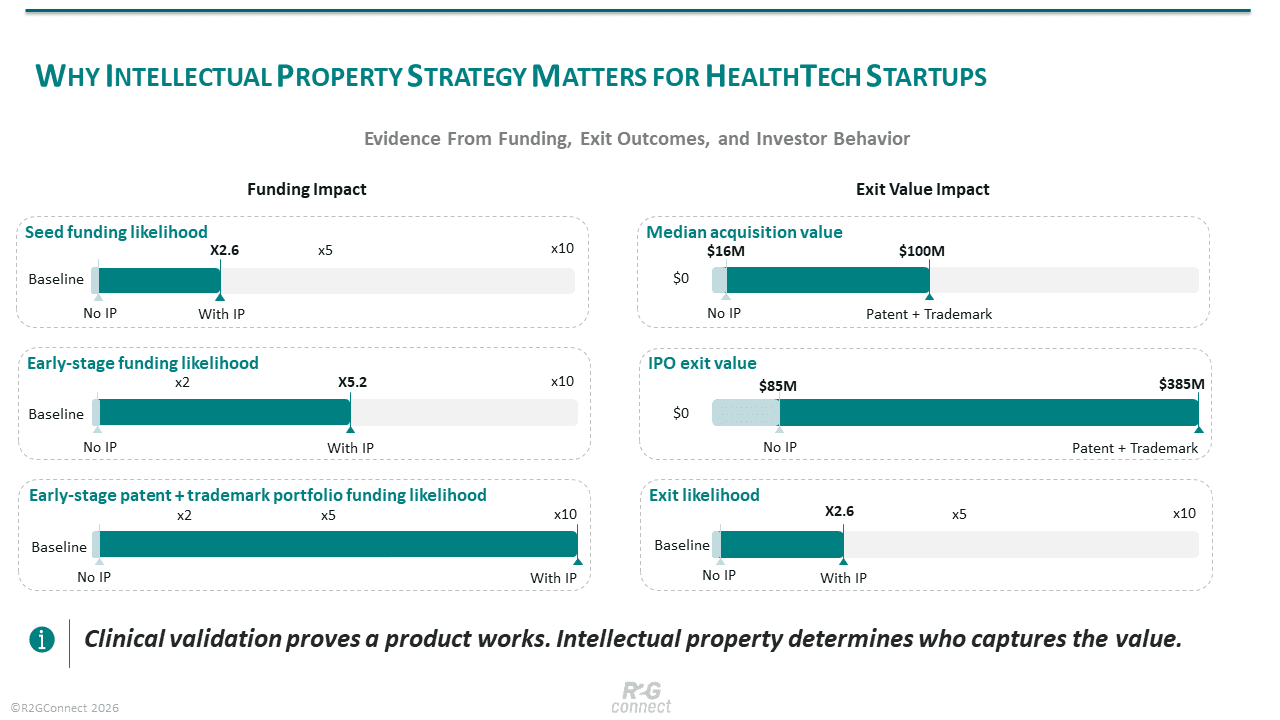
Large European startup datasets provide clear statistical evidence linking IP protection to funding outcomes² . Compared with startups that filed no intellectual property rights:
- startups with IP filings were 2.6× more likely to raise seed funding
- they were 5.2× more likely to secure early-stage investment
- companies that combined patents and trademarks were more than 10× more likely to receive early-stage funding² .
These patterns appear across industries but are particularly relevant in life sciences and medical technology, where defensibility is central to long-term value creation.
IP is also associated with stronger exit outcomes
Intellectual property also plays a significant role when startups reach acquisition or IPO stages.
Data from European startup exits show that companies with registered IP rights are over twice as likely to reach an exit compared with those without filings² .
The difference in valuations is also substantial. Median acquisition values in one dataset were roughly:
- $16M for startups with no IP filings
- $100M for startups holding both patents and trademarks²
This suggests that companies with well-defined IP positions are more attractive acquisition targets and can command significantly higher valuations.
IP can retain value even when startups fail
Another often overlooked aspect of intellectual property is its residual value.
Studies examining failed venture-backed startups found that approximately 70% of patents held by failed startups were later sold. In medical device startups specifically, about 61% of patents were sold after the company failed³ .
This explains why investors frequently treat patents as collateralizable assets. Even if a company’s commercial strategy does not succeed, the technology itself may still retain value.
Weak IP governance creates operational risks
The absence of an IP strategy not only affects fundraising, but it can also create operational risks that emerge later in a company’s lifecycle.
Common problems include:
- unclear ownership of technology developed by founders, employees, or research partners
- patent infringement risks due to missing freedom-to-operate analysis
- trade secret leakage through weak internal controls
- licensing or ownership issues uncovered during acquisition due diligence
Corporate surveys indicate that 85% of companies consider IP assets as important as or more important than other assets during acquisitions, highlighting how critical IP clarity becomes during strategic transactions² .
Not every healthtech company needs the same IP strategy
A key conclusion of the research is that the optimal IP strategy depends on the product category.
- For hardware-based medical technology, such as devices or sensors, patents are often essential because technical designs can be replicated once validated.
- For AI-driven diagnostics or data-driven platforms, competitive advantages often lie in proprietary datasets, training pipelines, or operational know-how. In these cases, trade secrets and data governance can be more valuable than patents.
- For digital health software products, defensibility may rely on a combination of intellectual property, regulatory compliance, distribution partnerships, and brand trust.
The goal is not to patent everything. The goal is to align the IP strategy with the product’s technical and commercial reality.
IP determines who captures the value of innovation
Clinical validation proves that a healthtech product works. Intellectual property determines who captures the value created by that innovation.
Startups that treat IP as an afterthought often encounter problems when investors conduct due diligence, when partners evaluate licensing agreements, or when potential acquirers assess ownership and enforceability.
Startups that integrate IP strategy early—alongside regulatory planning, product development, and commercialization—are better positioned to raise capital, build partnerships, and scale.
In healthcare markets defined by long development timelines and high regulatory barriers, intellectual property is not optional infrastructure. It is part of the foundation that turns innovation into a durable commercial impact.
An Opportunity for Digital Health Startups Using IP to Drive Real Impact
The World Intellectual Property Organization (WIPO) has launched the WIPO Global Awards Open Call, recognizing startups and SMEs that successfully turn innovation into real-world impact through effective IP strategies.
The program will select 10 awardees — five startups and five SMEs — plus special mentions. Selected companies receive:
- global recognition across WIPO’s network spanning 194 countries
- participation in a two-day workshop in Geneva
- six months of tailored IP and business mentorship
- access to a global innovation and investor network
Digital health applicants will be evaluated on four dimensions: 1. Business case and IP portfolio – market relevance, scalability, and how effectively IP protects core technology 2. IP commercialization strategy – use of IP to enable partnerships, licensing, expansion, or revenue growth 3. IP culture – how deeply IP awareness is embedded in team decision-making 4. Societal impact – measurable contribution to health outcomes, system efficiency, or broader social value
The opportunity is open to registered startups and SMEs from all 194 WIPO member states, with up to 300 employees and annual revenue below $15M, offering an innovative product or service protected (or being protected) through IP rights.
Healthtech startups building impactful digital health solutions are invited to apply. Apply here
Sources
¹ National Bureau of Economic Research — High Technology Entrepreneurs and the Patent System ² European Patent Office & EUIPO — Patents, Trade Marks and Startup Finance Study ³ National Bureau of Economic Research — Redeployment of Patents from Failed Startups