
Ask any early-stage HealthTech founder what keeps them up at night, and the answer is rarely "risk classification." It's fundraising, product-market fit, hiring. But for medical device and HealthTech startups building toward the EU market, one quiet decision made in the first months — how a product gets classified under the EU MDR — shapes almost everything that follows: cost, timeline, and whether investors take the regulatory plan seriously at all. Most pre-commercial companies aren't ready for it.
Medical Device Risk Classification Remains One of the Hardest Early-Stage Regulatory Steps
Annex VIII of the EU MDR sorts devices into Class I, IIa, IIb, or III based on intended use, invasiveness, duration of contact with the body, and whether the device is "active." It's a rulebook on paper. But in practice, it's a minefield for anyone without regulatory training — and most HealthTech founders come from engineering or clinical backgrounds, not regulatory affairs.
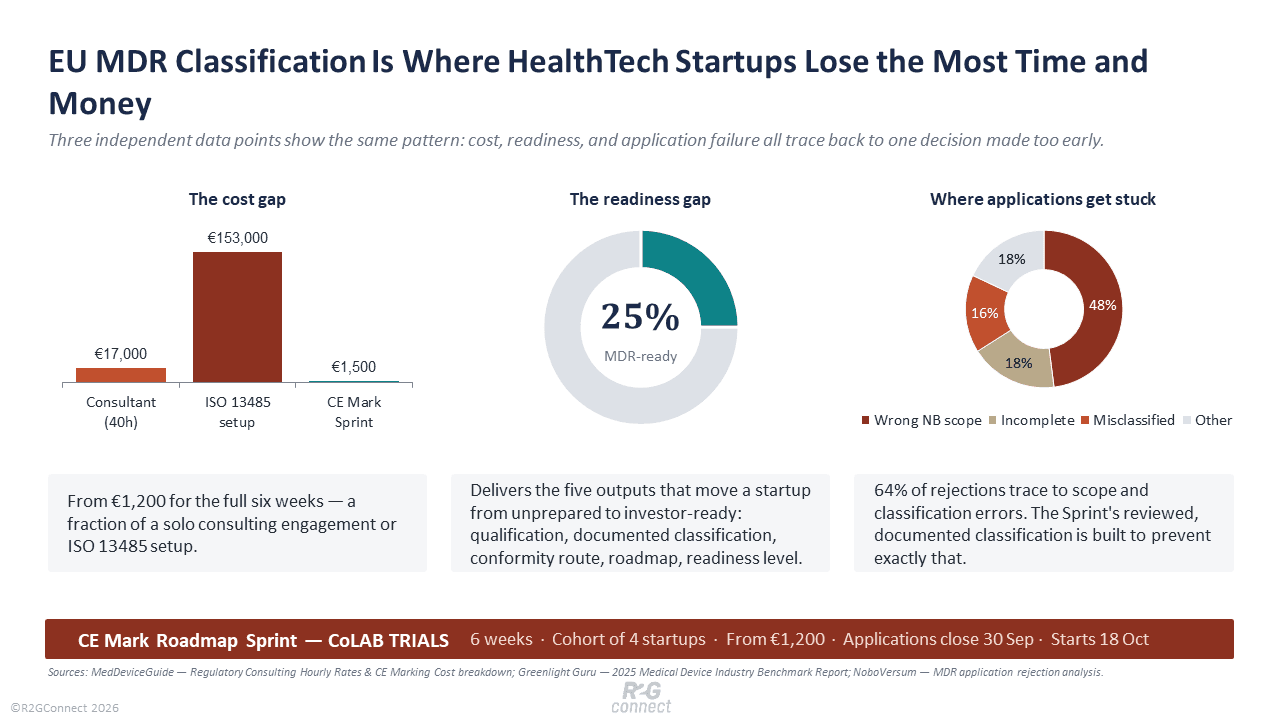
Only 25% of pre-commercial medtech companies describe themselves as highly prepared for EU MDR1. Classification is one of the biggest reasons why. A few things make it especially hard to get right on the first try:
- Software as a Medical Device (SaMD) now falls under Rule 11, which pushes most diagnostic or therapeutic software into Class IIa or IIb — and straight into Class III if a wrong decision could cause death or irreversible harm. Only genuinely “non-decision” software, like wellness tracking, stays in Class I2.
- Combination products — a device paired with a drug, or two devices working together — must be classified according to the highest-risk component, and founders routinely underestimate which component that is3.
- Borderline cases (device vs. medicinal product, device vs. IVD) are common enough that the MDR has a formal classification-dispute procedure for them, informally known as the Helsinki procedure4. None of this is exotic. It's the default terrain for anyone building connected diagnostics, decision-support software, or combination therapeutics in Europe.
Classification Errors Lead to Restarted Conformity Assessments and Investor Doubt
A misclassified device isn't a paperwork problem you fix later; it's a redo. Choosing too low a risk class typically means restarting conformity assessment under a stricter route: new Notified Body review, rewritten technical documentation, another round of consultant fees. Notified Bodies aren't forgiving of these errors either: an analysis of rejected MDR applications found that 48% failed because the manufacturer's chosen Notified Body sat outside its designated scope — often a downstream symptom of misjudging the device's class in the first place — with a further 16% rejected for classification errors outright and 18% for incomplete submissions5.
There's a funding angle too. A vague or shifting answer on classification, conformity route, and timeline reads as a warning sign in due diligence. A regulatory strategy that hasn't nailed down the basics signals that the team hasn't done the hard thinking yet — right when investors are deciding whether to write a check.
Most HealthTech Teams Lack In-House Regulatory Expertise and Underestimate the Cost of Outsourcing It
Here's the underlying issue: most HealthTech teams simply don't have anyone in-house who's done this before. Few early-stage teams can justify a full-time Regulatory Affairs hire before they even know their classification, so the work gets outsourced — and outsourcing isn't cheap:
- Specialized medical device regulatory consultants typically bill €100–425 per hour, depending on seniority and region6.
- At those rates, a focused 40-hour engagement to nail down classification and strategy lands somewhere in the €4,000–€17,000 range.
- Building out an ISO 13485 quality management system — a prerequisite most founders don't see coming — adds another €38,000–€153,000 in implementation and certification costs7. For a pre-revenue or early-revenue startup, that's a meaningful chunk of a seed round spent before the product has even entered formal conformity assessment.
Notified Body Capacity Has Not Kept Pace with MDR Application Volume
Even startups that classify correctly are running into a second bottleneck: Notified Body capacity. At last count, roughly 33,000 MDR applications had been submitted against about 17,500 certificates issued — leaving well over 15,000 devices in the queue, spread across only 51 active Notified Bodies8. Average review times now sit at 13–18 months for a completed certification9, longer for complex Class IIb/III devices. Submitting a clean, well-classified dossier the first time is no longer just good practice — it's the difference between clearing the queue and getting stuck in it.
Existing Regulatory Support Options Remain Expensive, Generic, or Surface-Level
None of this is unknown to the ecosystem — startups already have a few ways to get help, each with a catch.
Hiring a consultant works, but at the rates above, it's often out of reach pre-seed. Doing it yourself with online templates is cheaper, but founders routinely miss requirements they didn't know to look for. Regulatory-as-a-service platforms bridge some of the gap, but they're structured tools, not a substitute for judgment on a specific product's borderline calls. General accelerator programs touch on regulatory strategy among their broader workshops, but that's awareness-level exposure, not personalized guidance on any one company's device.
What's missing is something in between: expert-level, personalized guidance that doesn't require a five- or six-figure budget, and doesn't leave founders to interpret Annex VIII alone.
Expert Cohorts Offer a More Accessible Path to Regulatory Readiness
This is where R2GConnect’s expert cohort model earns its place. It's a genuine service innovation, not just cheaper consulting — the idea is to make real expert advice accessible to startups who could never otherwise afford dedicated, one-on-one regulatory support. In effect, it democratizes expert advice: instead of one company hiring one consultant, a small cohort shares access to regulatory experts across a structured program, at a fraction of the standalone cost.
The CE Mark Roadmap Sprint, delivered by CoLAB TRIALS, is built around exactly the problems above. Over six weeks, a cohort of four startups works through expert-led workshops on EU MDR classification and conformity assessment routes, then applies that knowledge to their own device through individual study weeks and one-on-one advisory sessions with regulatory experts. Each participant leaves with a documented risk classification, a defined conformity assessment route, a regulatory readiness level, and a roadmap they can put in front of investors — starting at €1,200, capped at four startups per cohort to keep the advisory sessions genuinely personal. Applications close 30 September 2026, ahead of an 18 October start.
Sources 1. Greenlight Guru — 2025 Medical Device Industry Benchmark Report (survey of 500+ industry professionals; EU MDR readiness statistic). 2. MDCG 2019-11 — Guidance on Qualification and Classification of Software in Regulation (EU) 2017/745 and (EU) 2017/746 (Rule 11 / SaMD). 3. European Commission — Manual on Borderline and Classification for Medical Devices under Regulation (EU) 2017/745 and (EU) 2017/746 (combination products, highest-risk-component rule). 4. Osborne Clarke — coverage of the codified classification-dispute ("Helsinki") procedure for borderline products. 5. NoboVersum — analysis of the most common reasons MDR applications are rejected (Notified Body scope, incomplete files, misclassification). 6. MedDeviceGuide — Medical Device Regulatory Consulting Hourly Rates by Region (2026). 7. MedDeviceGuide — How Much Does CE Marking Cost for Medical Devices? (ISO 13485 implementation and certification cost breakdown). 8. MedDeviceGuide — EU MDR Notified Body Capacity Crisis 2026–2027 (applications submitted vs. certificates issued, active Notified Body count). 9. RAPS — "Team-NB survey shows slowdown in growth of MDR and IVDR certificates issued in 2025" (average review timelines).