
Every jurisdiction imposes its own fees, documentation requirements, and post‑market duties. Beyond the obvious application fees lie hidden costs—translations, clinical studies, local agents, cybersecurity, audits, and the opportunity cost of delays. Understanding and planning for these expenses will help founders avoid budget shocks and position their company for a smooth launch.
Mapping regional cost ranges
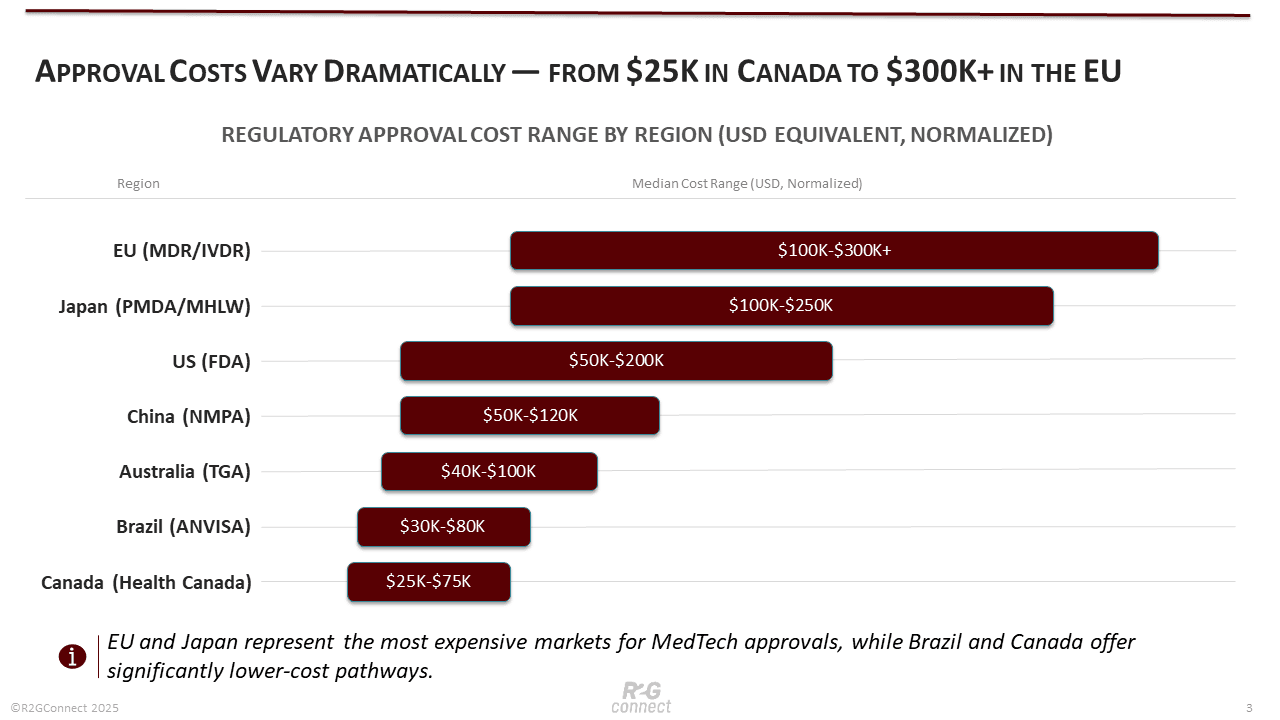
Costs vary widely across markets. The chart above summarizes typical median cost ranges (including application fees, external testing, and consultancy expenses) for obtaining regulatory approval in different regions. These figures convert local currencies to U.S. dollars for easy comparison. Europe, under the Medical Device Regulation (MDR), is often the most expensive terrain. Industry surveys suggest the total cost of certifying a single device under MDR can range from €200 000 to €600 000, driven by Notified Body fees, clinical evidence demands, translations, and quality‑management audits. The U.S. FDA appears cheaper at first glance—its user fees are around $20k for a 510(k) and about $600k for a PMA—but companies usually spend at least $50k–$200k on testing, quality systems, and consultants.
Japan’s PMDA approvals often cost $100k–$250k when clinical validation and local representation are factored in. China and Brazil can look inexpensive on paper, but mandatory type testing, local agents, and language translations push the total upwards. Canada and Australia fall in the mid‑range thanks to reliance pathways that leverage EU or U.S. evidence.
These cost bands should be viewed as ballparks for moderate‑risk Software as a Medical Device (SaMD). High‑risk, first‑of‑kind products can exceed them significantly.
Breaking down the core cost categories
- Regulatory fees and Notified Body assessments. Governments charge application and review fees (e.g., FDA user fees, PMDA assessment fees, Canada’s Medical Device License fees). In Europe, Notified Body audits can cost tens of thousands of euros. Class III or innovative AI/ML devices requiring design dossier reviews and expert panel consultations can push fees higher.
- Quality Management System (QMS) implementation. Building and maintaining an ISO 13485‑compliant QMS is a major expense. It involves writing and updating procedures, training staff, performing internal audits, and paying for annual surveillance audits. Many start‑ups underestimate the cost of implementing a QMS from scratch.
- Technical documentation and gap remediation. Compiling the technical file (device description, software architecture, risk management, verification/validation, clinical evaluation, cybersecurity plan) consumes hundreds of hours. External consultants may be needed to perform usability studies, hazard analyses, and IEC 62304 documentation. Catching deficiencies early is cheaper than resubmitting a dossier after rejection.
- Clinical evidence generation. Clinical investigations and real‑world evidence collection are often the largest hidden costs. For many SaMD products, regulators will require prospective or retrospective studies to demonstrate safety and performance. Designing and managing these trials is costly; a single multi‑centre study can easily exceed $100k. Coordinating ethical approvals, site selection, and data analysis adds to the cost.
- Translations and local representation. EU MDR mandates that instructions for use and labels be translated into all EU languages; China requires Simplified Chinese; Brazil requires Portuguese. Translating documentation, software interfaces, and marketing materials can add thousands to tens of thousands of dollars. Furthermore, most markets require a local authorised representative, who charges annual fees and handles regulatory correspondence.
- Testing and certification. Compliance with standards like IEC 62304 (software lifecycle), IEC 62366 (usability), ISO 14971 (risk management), IEC 81001‑5‑1 (cybersecurity), and electrical safety standards often requires third‑party testing. Each test can cost between a few thousand and tens of thousands of dollars, depending on complexity.
- Cybersecurity and data privacy compliance. Recent laws (e.g., the FDA’s “cyber devices” mandate and the EU’s upcoming Cyber Resilience Act) require a cyber‑risk management plan, a software bill of materials, and ongoing patch management. Creating these artefacts may require new toolsets, penetration testing, and possibly third‑party audits.
- Post‑market surveillance and periodic reporting. Once approved, the expenses continue. MDR requires periodic safety update reports (annual or biennial), post‑market clinical follow‑up, incident reporting, and trending analysis. The FDA expects manufacturers to submit adverse‑event reports and maintain complaint files. Each new major software update may trigger re‑approval or re‑certification, especially in Europe, where adaptive algorithms are not yet fully accommodated. Budgeting 15–20 % of annual revenue for post‑market activities is common.
- Opportunity cost of delays. Notified Body queues and regulator backlogs can delay market entry by months. The EU’s MDR backlog means initial approvals can take 9–24 months; each month of delay is lost revenue and burns cash. Hiring experienced regulatory strategists early can help identify the fastest feasible route and avoid iterative delays.
- Cost of change management. Introducing new features, adapting AI models, or expanding to new markets triggers additional regulatory submissions. Without a predetermined change‑control plan (e.g., FDA’s Predetermined Change Control Plan), each update can mean significant additional fees and testing.
Hidden costs across regions
-
Europe (MDR/IVDR): Hidden costs include Notified Body shortages (higher prices for audits), EUDAMED registration, and EU‑specific legal fees (e.g., clinical evaluation expert reviewers). Unique Device Identifier (UDI) labelling and data entry add administrative overhead.
-
United States: The FDA can impose post‑market surveillance studies (522 studies) that cost millions. Also, quality‑system inspections by the FDA are separate from ISO audits and can result in warning letters if issues are found, triggering expensive remediation.
-
Japan: Local clinical validation is often required. The PMDA demands Japanese translations of all documents and may have unique cybersecurity expectations. Retaining a Designated Marketing Authorization Holder adds ongoing costs.
-
China: Mandatory in‑country testing at NMPA‑accredited labs and potential requirements to host data on local servers (with compliance to China’s Personal Information Protection Law) add complexity. The NMPA may require that algorithm training data include Chinese populations.
-
Brazil: ANVISA requires Brazilian Good Manufacturing Practice certification. Companies without MDSAP audits must pay for an ANVISA inspection team to travel to the factory. All labelling must be in Portuguese and include local importers’ details.
-
Canada/Australia: While more straightforward, both jurisdictions impose annual fees for maintaining device licences or ARTG listings. MDSAP certification is mandatory for Canada, which has its own cost.
Strategies for controlling costs
- Plan early and classify correctly. Misclassification can derail budgets, so start with a free one‑hour Roadmap CE Certification consultation from BAYOOCARE. It maps out your CE‑marking strategy, clarifies MDR/IVDR classification, and helps you decide whether to pursue CE first, FDA first, or both concurrently.
- Invest in a solid QMS from day one. Implementing an ISO 13485‑compliant quality system can be more cost‑effective with BayooMED’s Fast‑Track to Certification programme. In just four weeks, it establishes a QMS that aligns with both MDR and FDA requirements, saving months of internal effort and ensuring your processes meet regulators’ expectations from the outset.
- Audit your documentation. Before Notified Bodies or regulators do, have experts identify gaps in your technical file. CEED | Charité’s Technical Documentation Gap Analysis covers device description, risk management, clinical evaluation, and cybersecurity documentation, helping you avoid expensive resubmissions.
- Engage regulatory experts for trial design. To avoid duplicative clinical trials, partner with CoLAB TRIALS for Regulatory Strategy & Project Management. They combine clinical trial design with regulatory submission preparation across multiple jurisdictions, coordinating documentation so one study can satisfy both FDA and MDR requirements.
- Generate clinical evidence early. Access to real‑world data can accelerate approvals and prevent costly redesigns. R2GConnect’s Hospital/Clinical Validation Services partner with hospitals to run pilot studies, providing usability feedback and clinical evidence before full‑scale trials.
- Leverage equivalence and reliance pathways. Canada, Australia, and parts of Asia accept EU or U.S. approvals as evidence, reducing duplication. In Germany, explore reimbursement pathways like DiGA or DiPA early. TÜVIT’s Free 60-Minute Consultation on DiPA Reimbursement helps outline how to qualify digital nursing-care applications and recover costs faster.
- Budget for translations and local representation. Don’t underestimate language requirements or authorised representative fees. These often account for 10–15 % of a European submission’s cost and can be minimised by planning translation workflows and verifying local representation arrangements upfront.
- Develop a robust cyber plan. AI and cybersecurity requirements are evolving quickly. TÜVIT’s EU AI Act Briefing & AI Risk Navigator is a free 60‑minute consultation that explains high‑risk AI requirements, risk management, and documentation expectations, helping you integrate AI‑specific compliance costs into your cybersecurity strategy early.
- Be mindful of future updates. Factor in the cost of maintaining the CE certificate or 510(k). Each new software version may need review; designing change‑control plans (like FDA’s PCCP) can save significant future expenses.
- Monitor the regulatory horizon. New regulations (e.g., the EU AI Act, Cyber Resilience Act) will add compliance layers; plan budgets to meet them early.
- Treat compliance as a competitive advantage. A well‑structured regulatory approach not only saves money but also builds trust with investors, clinical partners, and customers. Cost‑effective compliance signals maturity and reduces risk in due diligence.
By integrating these services, founders can transform compliance from a cost centre into a competitive advantage. Leveraging expert support at the right time reduces the risk of unforeseen expenses, shortens time‑to‑approval, and helps deliver life‑changing digital health innovations to patients more efficiently.