
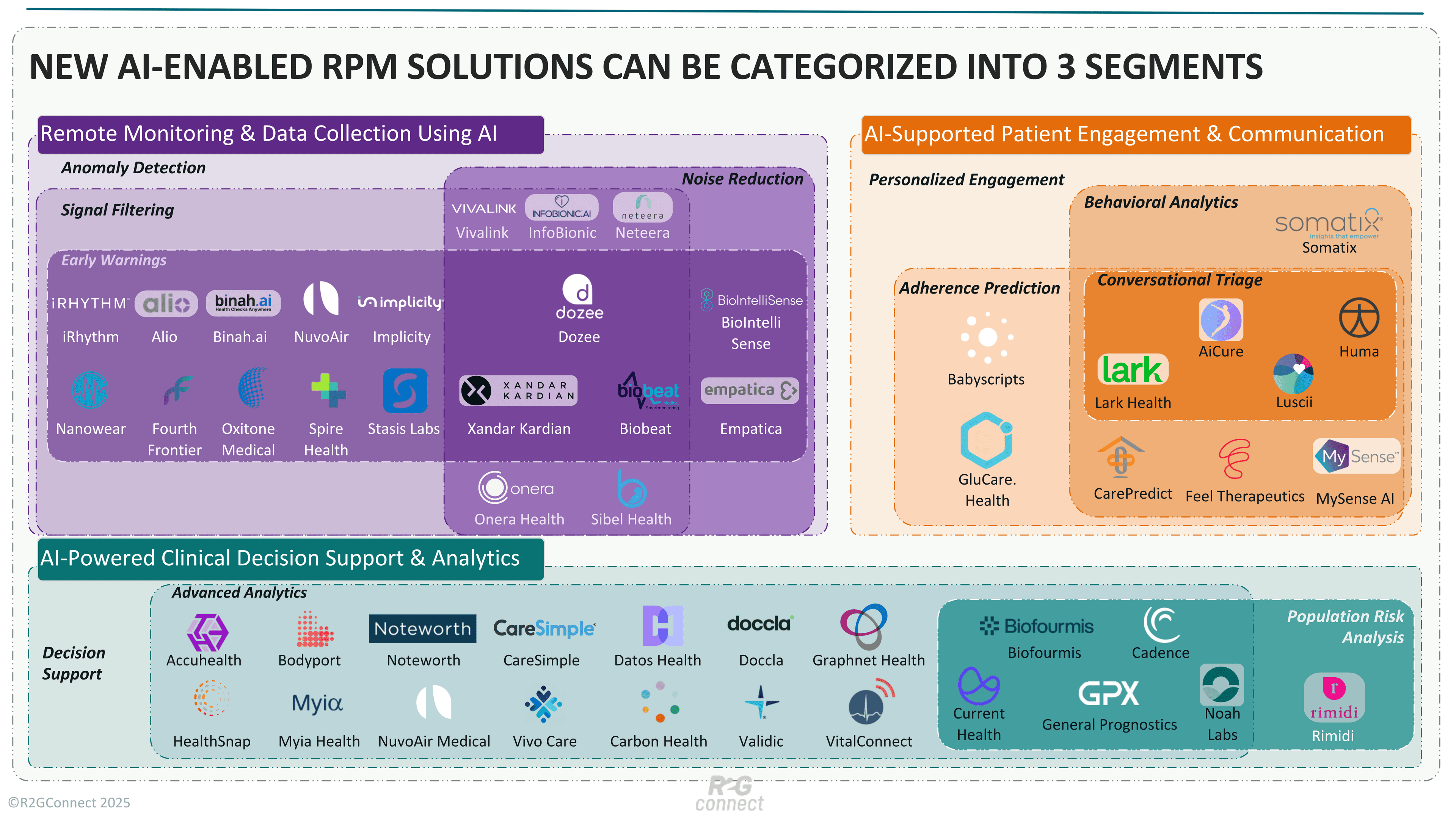
Remote Patient Monitoring (RPM) has evolved far beyond wearable sensors. Today’s landscape spans device-based monitoring, analytics platforms, and intelligent patient engagement tools. As the category matures, AI is reigniting investor interest by transforming RPM from passive data collection into active, predictive, and personalized care. Across the RPM spectrum, three distinct categories are emerging, each defined by how AI enhances data collection, clinical intelligence, and patient engagement.
Category: Remote Monitoring & Data Collection Using AI
Definition: Solutions that collect continuous patient data (vitals, activity, physiological signals) outside of traditional care settings and use AI to detect anomalies or provide early warnings. These systems typically integrate device or sensor data into clinician dashboards.
AI Roles in Remote Monitoring and Data Collection:
1. Anomaly Detection What it means: AI algorithms continuously analyze physiological data streams (like heart rate, blood pressure, oxygen levels, or motion) to detect abnormal patterns or deviations from a patient’s baseline or population norms.
Purpose: To automatically flag early signs of deterioration (e.g., arrhythmias, hypoxia, irregular respiration, falls) without requiring constant human review.
Example in practice:
-
Implicity uses anomaly detection to identify irregular heart rhythms in patients with implanted cardiac devices.
-
Biobeat detects sudden changes in blood pressure or oxygen saturation and sends alerts to clinicians.
2. Signal Filtering What it means: AI models clean raw physiological data collected from sensors, removing artifacts caused by motion, poor sensor contact, or environmental noise. This ensures the system only processes reliable, clinically meaningful data.
Purpose: To improve the accuracy of vital sign readings and prevent false alerts caused by technical noise.
Example in practice:
-
iRhythm’s Zio patch filters out ECG artifacts from movement or electrical interference before analyzing rhythms.
-
Dozee filters noise in contactless sleep and respiration data captured from bed sensors.
3. Noise Reduction What it means: Noise reduction is similar to signal filtering but broader; it involves using AI to distinguish true physiological signals from irrelevant or misleading data across multiple sensors or environments.
Purpose: To make sure clinicians see stable, interpretable data trends rather than raw, noisy signals. It often utilizes deep learning models trained to distinguish between “clean” and “noisy” data patterns.
Example in practice:
-
Onera Health reduces background noise in sleep EEG recordings to produce clinically usable sleep stage data.
-
Binah.ai removes visual noise (lighting, motion, skin tone variation) from camera-based vitals detection.
4. Early Warnings What it means: AI identifies subtle, pre-symptomatic trends indicating a patient may deteriorate, even before clinical thresholds are crossed. This can include small changes in heart rate variability, respiratory rate, or sleep quality that precede an adverse event.
Purpose: To alert clinicians early enough to intervene proactively, reducing hospitalizations and complications.
Example in practice:
-
VitalConnect predicts potential cardiac events or postoperative complications from continuous ECG and temperature data.
-
Dozee provides early warning scores to nurses for patients showing signs of respiratory distress or infection.
Category: Clinical Decision Support & Analytics RPM
These startups don’t just collect patient data; they interpret it. Their AI transforms RPM data (from sensors, wearables, EHRs, labs, etc.) into clinical insights that help healthcare providers make better, faster, and more personalized decisions.
The three core AI roles in this category are:
AI Roles in Clinical Decision Support and Analytics:
1. Advanced Analytics What it means: AI models analyze large, complex, or continuous data sets from multiple sources (wearables, medical devices, lab data, EHRs) to uncover hidden patterns or correlations that humans might miss.
Purpose: To give clinicians richer situational awareness, e.g., which patients are trending toward deterioration, how treatment adherence affects outcomes, or how recovery metrics evolve.
Example in practice:
-
Biofourmis uses AI to analyze continuous vitals, symptoms, and medication data, then models a patient’s baseline to identify deviations from their norm.
-
Myia Health combines patient-reported data with wearable metrics to help clinicians spot subtle health changes before they become critical.
2. Population Risk Prediction What it means: AI analyzes data across many patients (a population) to predict which individuals or cohorts are most likely to experience adverse outcomes, e.g., readmission, heart failure exacerbation, or sepsis risk.
Purpose: To help health systems or care teams prioritize resources by identifying high-risk patients early, supporting value-based care models, and chronic disease management programs.
Example in practice:
-
Current Health uses AI to stratify risk across all remotely monitored patients, allowing clinicians to focus on those showing early signs of decline.
-
HealthSnap aggregates population-level RPM data to predict which patients with hypertension or diabetes are most likely to require intervention soon.
3. Decision Support What it means: AI tools deliver specific, actionable recommendations or alerts to clinicians, for instance, suggesting therapy adjustments, highlighting high-risk trends, or flagging data that requires follow-up.
Purpose: To guide clinical action based on evidence and predictive analytics, rather than raw numbers.
Example in practice:
-
VitalConnect provides dashboards that recommend escalation pathways when cardiac metrics cross AI-defined risk thresholds.
-
Cardiologs uses AI ECG interpretation to support cardiologists in diagnosing arrhythmias faster and more accurately.
-
Optimize Health integrates AI-driven decision rules into its RPM dashboard, helping clinicians decide when to intervene.
Category: AI-Supported Patient Engagement & Communication RPM
Definition: Solutions that combine RPM with AI-driven engagement, behavioral insight, and communication tools to improve patient adherence, motivation, and provider–patient interaction. They focus on helping patients stay connected, follow care plans, and maintain long-term health behavior changes while giving clinicians visibility into adherence and engagement metrics.
AI Roles in Patient Engagement & Communication:
1. Personalized Engagement What it means: AI customizes communication and educational content for each patient based on their condition, lifestyle, and interaction patterns. The system learns what works best for each person — timing, tone, content type — and adjusts accordingly.
Purpose: To keep patients motivated and adherent through individually tailored reminders, messages, and interventions.
Example in practice:
-
Huma (UK) uses AI to personalize patient communication for chronic disease management and recovery journeys.
-
Feel Therapeutics (Greece/US) adapts stress management support based on emotional state and wearable data.
2. Conversational Triage What it means: AI chatbots or voice agents interact with patients through text or speech to check symptoms, answer questions, and escalate urgent issues to clinicians. They use NLP (natural language processing) to handle basic interactions autonomously.
Purpose: To scale communication, reduce clinician workload, and ensure patients get immediate, context-aware responses.
Example in practice:
-
Luscii (Netherlands) uses AI chatbots for daily patient symptom check-ins.
-
Huma (UK) integrates conversational follow-ups for post-acute care patients.
3. Adherence Prediction What it means: AI models analyze behavioral, physiological, and interaction data to predict when a patient is at risk of non-adherence — for example, skipping vitals tracking or missing medication.
Purpose: To enable proactive outreach by clinicians before adherence drops, improving clinical outcomes and patient satisfaction.
Example in practice:
-
CarePredict (US) flags patients showing early signs of disengagement (e.g., decreased activity or social interaction).
-
Somatix (US/Israel) detects reduced adherence by analyzing gesture and activity data.
4. Behavioral Analytics What it means: AI analyzes patterns in a patient’s daily behaviors, routines, and digital interactions to uncover insights about lifestyle factors (e.g., sleep, diet, stress, movement) that influence clinical outcomes or engagement.
Purpose: To help clinicians understand how lifestyle or mental state affects care adherence and to personalize interventions that address underlying behavioral risks.
Example in practice:
-
GluCare.Health (UAE) correlates glucose levels with lifestyle data (steps, meals, stress) to optimize diabetes management.
-
Feel Therapeutics (Greece/US) uses wearable behavioral data to map mood, stress, and therapy engagement patterns over time.
A Call to HealthTech Founders
Are you building the next generation of AI-enabled RPM solutions? Apply now to pitch at the upcoming R2G Connect Healthtech Pitch Event. Connect with leading investors, healthcare innovators, and partners shaping the future of remote care.