
HealthTech companies operate at the intersection of multiple complex domains. A single product may involve medical software development, regulatory classification under MDR, clinical validation, interoperability standards, cybersecurity compliance, and reimbursement strategy.
Few startups have in-house specialists across all these areas. External experts, therefore, become essential partners throughout the product lifecycle.
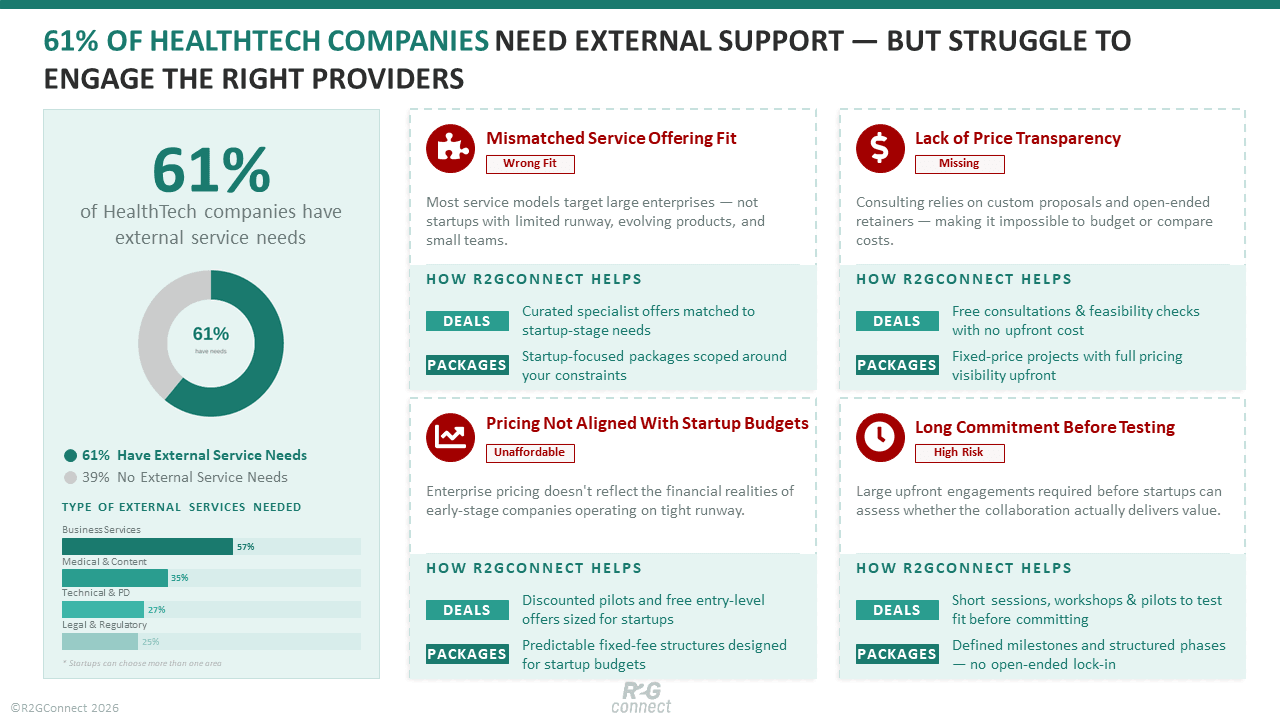
According to the R2GConnect database, 61% of HealthTech startups request external support from providers such as:
- Regulatory and compliance experts
- Medical software and AI developers
- Clinical validation specialists
- Hardware and firmware engineers
- Market access and commercialization consultants
External expertise allows startups to move faster, avoid costly regulatory mistakes, and accelerate market readiness. However, accessing the right expertise remains difficult.
The Main Obstacles When Engaging Service Providers
HealthTech founders frequently encounter structural barriers when searching for external partners. 1. Pricing Transparency Is Often Missing Consulting and specialized development services frequently rely on custom proposals or open-ended retainers.
2. Quality Is Difficult to Evaluate Startups often rely on referrals or brand reputation rather than objective evaluation.
3. High Commitment Before Testing Traditional consulting engagements often require large commitments before a startup can determine whether the collaboration is effective.
4. Misalignment With Startup Constraints Many service offerings are designed primarily for large enterprises rather than early-stage companies.
Startups operate under different constraints:
- limited financial runway
- rapidly evolving product concepts
- uncertain regulatory positioning
- small internal teams
Service formats designed for corporations do not always translate well to startup environments.
The Missing Step: Low-Risk Exploration
What many HealthTech startups need first is not a large consulting engagement, but a low-risk way to explore expertise.
Short consultations, workshops, feasibility checks, or pilot engagements allow startups to test a provider’s knowledge before committing to a larger collaboration.
These interactions provide immediate value. A single session with the right expert can clarify regulatory classification, technical architecture risks, or clinical evidence requirements early in the development process.
Reducing the risk of initial engagement is the idea behind R2GConnect Deals.
R2GConnect Deals: Try Expert Services Before Committing
The R2GConnect Deals allows HealthTech startups to access curated offers from specialized service providers.
Instead of committing immediately to a full consulting project, startups can test expertise through structured offers such as:
- free consultation sessions
- technical feasibility checks
- expert workshops
- architecture reviews
- regulatory strategy sessions
- free API trials or platform access
- discounted pilot collaborations
These offers allow startups to evaluate expertise in a practical context before investing in larger projects.
For example, a startup developing a wearable-enabled product may start with a wearable data integration feasibility session. A company building an AI-based clinical tool might run a regulatory classification review before committing to a full compliance project.
By lowering the entry barrier to expert collaboration, Deals reduce risk for startups while helping service providers demonstrate their expertise. Explore current offers: https://www.r2gconnect.com/deals
Service Packages: Fixed-Price Collaboration Models
While Deals allow startups to test expertise, many founders still need predictable structures when moving into full projects.
To address this challenge, we introduced Service Packages.
Service Packages are fixed-price projects and service offerings designed for companies that require budget transparency and planning certainty when working with consultants, technology providers, and domain experts.
Each package defines:
- project scope
- deliverables
- duration
- fixed pricing
This structure allows startups to plan budgets more reliably while still accessing specialized expertise.
Examples of Service Packages currently available on R2GConnect include:
Clinical & Regulatory Expertise
- Clinical Usability Testing – Validating MedTech for Real-World Use (CEED | Charité)
- Regulatory Strategy – Navigating MDR, AI Act & Data Act Compliance (CEED | Charité)
Market and Growth Strategy
- Market Due Diligence Project for Digital Health Companies (Research2Guidance)
Product Design and Branding
- Design of Fundraising Assets (especially Pitch Deck) (Halo Lab)
Hardware and Technical Development
- Hardware Validation Sprint (1 Day) (Punktum)
Market Expansion
- EU Country Market Entry Planning (NSB Project)
These fixed-price formats allow startups to access specialized expertise without entering open-ended consulting arrangements. Explore Service Packages: https://www.r2gconnect.com/service-packages
Understanding What Startups Actually Need
Many founders report that existing collaboration models lack pricing transparency or do not reflect the financial realities of early-stage companies. To better understand market expectations, we launched the HealthTech Startup Growth Support Survey.
The survey examines how startups want to engage with service providers, focusing on topics such as:
- preferred pricing models
- acceptable budgets for fixed-price projects
- maximum monthly retainers
- interest in standardized service packages
- openness to equity-based collaboration models
- demand for AI-supported service formats
The goal is to identify gaps between startup expectations and current service offerings.
Participants in the survey receive access to the aggregated industry results, enabling benchmarking against peer companies and gaining insight into emerging service collaboration models.
The survey takes approximately five minutes to complete, and all responses are anonymous. Participate in the survey: here
Building Better Collaboration Models
HealthTech innovation depends not only on great products, but also on access to the right expertise at the right time. Startups need faster ways to evaluate service providers, lower-risk entry points for collaboration, and clearer pricing structures when moving into larger engagements.
As the HealthTech ecosystem continues to evolve, improving how startups access expertise may become just as important as the innovations they build.