Why Vendor Selection Matters Companion app selection now involves brand, medical affairs, IT, compliance, regulatory, and market access teams, not just marketing. The right vendor can deliver measurable clinical and commercial outcomes, including:
- Improved patient adherence and persistence
- Increased therapy continuity
- Prescription uplift
- Generation of real-world evidence (RWE)
The R2GConnect Framework R2GConnect offers a structured approach to identify and benchmark companion app vendors. Key features include:
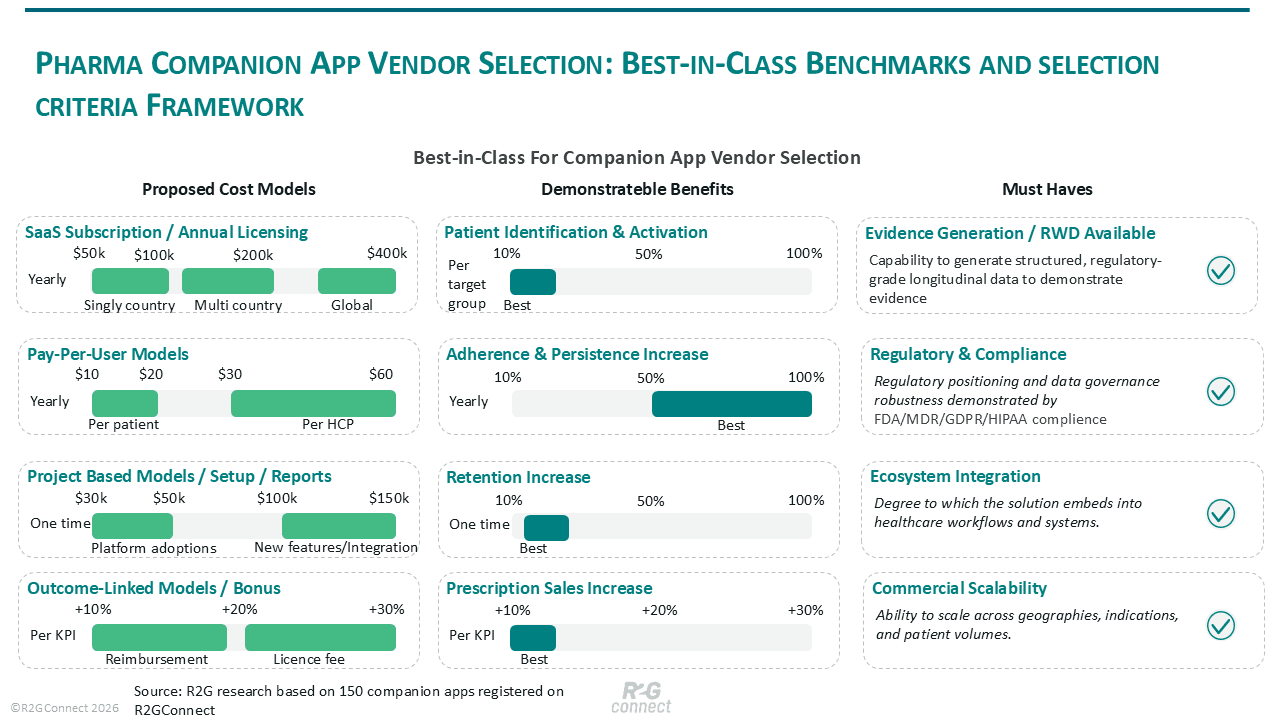
- Pricing benchmarks across SaaS, pay-per-user, and outcome-linked models
- Performance metrics for adherence, persistence, retention, and prescription impact
- Strategic capability assessment to distinguish tactical apps from best-in-class platforms
Companion apps come in a variety of formats depending on the patient and therapeutic needs. Sensor-enabled platforms like Propeller Health integrate connected devices with adherence tracking to improve medication use.
Large-scale engagement platforms such as Medisafe provide reminders, education, and persistence support across multiple chronic conditions. Behavioral coaching solutions like SwissDTx emphasize sustained lifestyle and self-management changes.
Messaging-first platforms, exemplified by Gerresheimer, leverage conversational AI within familiar communication channels to reduce patient friction.
Data-centric platforms such as Monsenso focus on structured ePRO capture and longitudinal outcome monitoring, while comorbidity-focused platforms like XO Life are designed to support patients managing multiple conditions simultaneously.
Despite these differences, all credible vendors must demonstrate measurable clinical and commercial impact within transparent contract structures.
Understanding Cost Models 1. SaaS / Annual Licensing
- Single-country: USD 60,000–120,000/year
- Multi-market or enterprise: USD 250,000–400,000/year Covers infrastructure, hosting, compliance, analytics dashboards, and support.
2. Pay-Per-User
- Patient apps: USD 1–3/month
- HCP-focused: USD 30–60/year Volume discounts often apply above 10,000 users.
3. Project-Based Fees
- Brand customization: USD 30,000–60,000
- CRM/EHR integration: USD 100,000–150,000
- Can significantly raise first-year costs.
4. Outcome-Linked Models
- Performance bonuses tied to KPIs such as adherence or activation
- Requires robust measurement frameworks
Annual budgets for EU single-brand deployments typically range USD 180,000–300,000, with global enterprise solutions exceeding USD 500,000.
Benchmarking Vendor Performance Core benefit dimensions include:
- Patient Activation: Target 10–15% of eligible patients in year one
- Adherence & Persistence: 30–58% improvement in adherence; 3–6 month persistence extension
- Retention: >15% increase among drug-and-app users
- Prescription Uplift: 10%+ increase in prescriptions for engaged populations
Must-Have Vendor Capabilities 1. Evidence Generation & RWE Capture – Regulatory-grade data, structured ePRO, interoperability (FHIR/HL7) 2. Regulatory & Compliance Readiness – Device classification, ISO certifications, cybersecurity, pharmacovigilance 3. Ecosystem Integration – EHRs, CRMs, pharmacy connectivity, care team dashboards 4. Commercial Scalability – Global reach, multi-language support, white-labeling, enterprise SLAs
Takeaway With companion apps poised to become standard in specialty and chronic therapies, pharma companies must adopt a systematic, data-driven selection process. The R2GConnect framework helps identify the right vendors, reduce evaluation risk, and align cross-functional teams to deliver measurable outcomes.
For more information, visit R2GConnect Innovation Scouting or contact hello@research2guidance.com.