
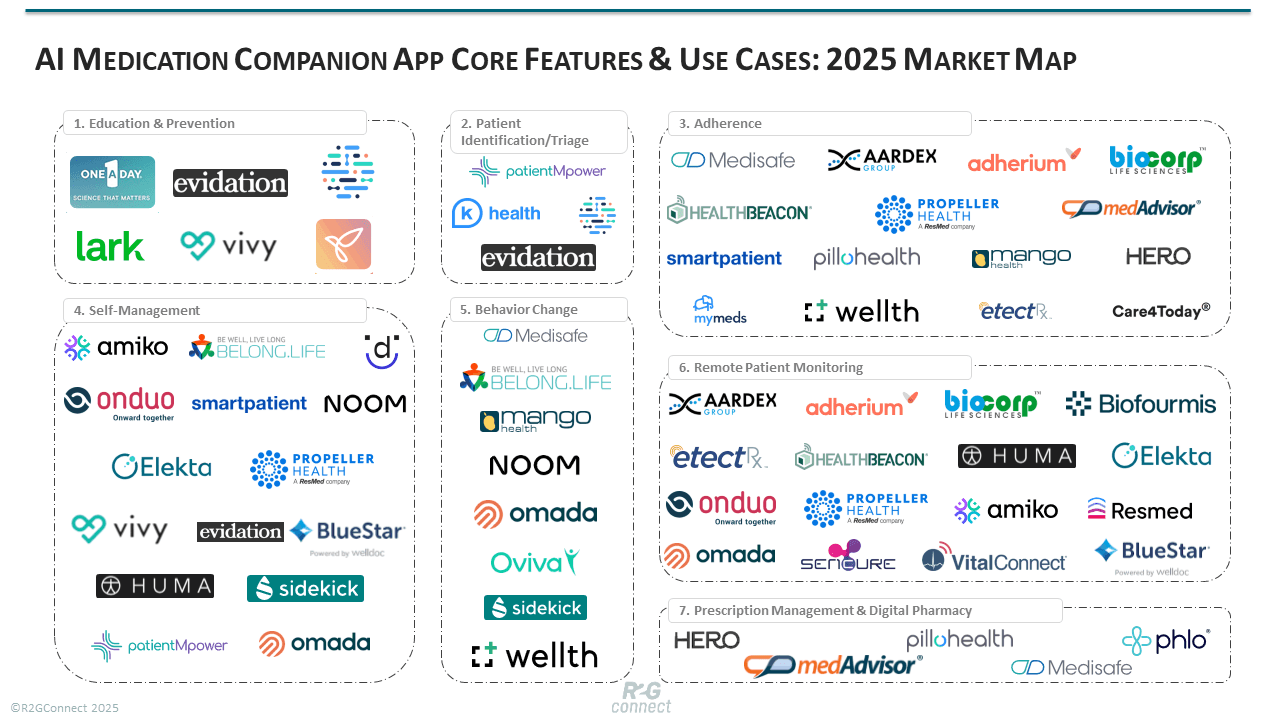
According to Research2Guidance’s Pharma Digital Companion Report (2025), roughly 300 companion apps are active today. By 2029, this number is expected to exceed 3,000. While this still represents just a fraction of global drug portfolios—around 2.5% of all prescription drugs—the growth signals that pharma is beginning to treat companion solutions as an integral commercial and clinical asset rather than a marketing add-on.
Companion apps are digital tools—often mobile apps or connected platforms—that complement the use of a specific pharmaceutical drug or medical device. Their functions range from simple medication reminders to complex data ecosystems integrating sensors, telehealth, and predictive analytics. The primary goal remains consistent: support better adherence, enhance patient experience, and generate data-driven insights that can inform R&D and commercialization strategies.
Seven Categories Shaping Pharma’s Companion App Landscape
While the main purpose of any companion app is to enhance patient engagement and improve adherence, companion apps can be divided into seven main categories based on their core function, features, and place in the treatment journey. Each is evolving with AI capabilities that expand its scope, from prevention and triage to long-term remote monitoring.
1. Education & Prevention
These companions build awareness around disease areas and early prevention, often linked to OTC or pre-diagnosis stages. AI models personalize educational content and preventive recommendations to fit user profiles.
-
Core AI Roles: Personalized Health Profiling, Content Recommendation, Clinical Knowledge Summarization,
-
Representative Solutions: Bayer’s One A Day Age Factor, MedWise Advisor (Cureatr), First Databank (FDB), Epocrates (Athenahealth), Lexicomp (Wolters Kluwer), Micromedex AI (IBM Watson Health), Vivy
AI here isn’t about automation, it’s about relevance. Language models and knowledge graphs interpret medical literature and patient profiles to deliver targeted, understandable health education. For pharma, these tools extend reach into the pre-diagnosis phase, fostering brand trust before treatment even begins.
2. Patient Identification & Triage
This category focuses on helping undiagnosed or misdiagnosed patients find the right treatment pathway faster.
-
Core AI Roles: Symptom Inference, Patient Matching & Eligibility Prediction, Medication Risk Scoring / Polypharmacy Risk Prediction, Behaviour Analytics & Risk Stratification
-
Representative Solutions: Ada Health’s collaboration with Novartis, PatientMpower, MedWise Advisor (Cureatr), Evidation Health
AI uses natural-language processing and probabilistic reasoning to interpret patien-reported symptoms, detect potential conditions, and connect patients to HCPs or therapy programs. For pharma, triage tools shorten the diagnostic journey and reveal eligible patient populations for emerging therapies, especially in rare and complex diseases.
3. Adherence
Adherence remains the commercial cornerstone of companion app investments. Predictive and behavioral AI now allow pharma to move beyond static reminders to dynamic, personalized engagement systems.
-
Core AI Roles: Predictive Adherence Modeling, Context-Aware Reminder Optimization, Behavioral Reinforcement Learning, Device-Based Behavioral Analytics
-
Representative Solutions: Medisafe (Boehringer Ingelheim’s Pradaxa), MyTherapy (smartpatient), and Wellth, Care4Today (J&J), Mango Health, MyMeds, AARDEX Group, Adherium, ETectRx, HealthBeacon, Hero Health, Pillo Health
Machine-learning models analyze user behavior and routine data to predict when doses are likely to be missed. Reinforcement algorithms adjust notification timing or tone based on prior interactions, while connected devices verify real dosing behavior.
According to R2G forecasts, such AI-driven adherence improvements could raise adherence rates by 36% and patient retention by 15%, adding over $20 billion in incremental annual drug sales by 2029.
4. Self-Management
Self-management companions help patients take control of chronic conditions while providing continuous feedback to clinicians.
-
Core AI Roles: Multimodal Health Data Fusion, Predictive Clinical Monitoring, Adaptive Coaching Systems, Predictive Engagement & Risk Stratification
-
Representative Solutions: Propeller Health’s platform (Novartis), dibi app, Kaiku Health, Sidekick Health, Belong.Life,Amiko, Noom, Omada Health, Onduo (Verily / Sanofi), Evidation Health, Huma, MedAdvisor
AI integrates wearable, sensor, and behavioral data to detect early complications and recommend corrective actions. These platforms transform therapy into a continuous digital feedback loop, generating valuable real-world evidence (RWE).
For pharma, these data streams supply valuable RWD for post-market analysis and market access documentation.
5. Behavior Change
Behavior change companions extend beyond medication adherence into habit formation and long-term lifestyle modification—key for metabolic and mental-health therapies.
-
Core AI Roles: Adaptive Coaching Systems, Cognitive-Behavioral Optimization & Motivation Prediction, Behavioral Reinforcement Learning
-
Representative Solutions: Oviva (linked to GLP-1 therapies), Noom’s clinical partnerships with Novo Nordisk, Wellth, Sidekick Health, Omada Health, Belong.Life, Mango Health
AI-powered coaching models use reinforcement learning and sentiment analysis to detect motivation levels and tailor interventions accordingly. Rather than delivering generic prompts, they adapt to the user’s psychological state, celebrating progress, addressing relapse risk, or adjusting difficulty levels dynamically. The result is sustained engagement that supports long-term outcomes, improved adherence, and payer-relevant value creation.
6. Remote Patient Monitoring (RPM)
Remote monitoring solutions bring AI into continuous, data-rich care environments. They combine wearable devices, smart injectors, and connected apps to track patient health in real time.
-
Core AI Roles: Predictive Clinical & Health Monitoring, Anomaly Detection & Temporal Outcome Forecasting
-
Representative Solutions: Kaiku Health (Novartis Oncology), Biocorp x Sanofi’s smart insulin pens, Propeller Health (ResMed), Biofourmis, VitalConnect, Sencure, Huma, Onduo (Verily / Sanofi), Amiko, HealthBeacon, ETectRx, Capsule Technologies (Philips)
Machine-learning models detect deviations in vital signs or symptom patterns and alert clinicians before deterioration occurs. Generative AI tools summarize patient data into digestible clinical reports. For pharma, RPM companions close the loop between drug use and outcomes, supporting pharmacovigilance, post-market safety, and outcome-based contracting.
7. Prescription Management & Digital Pharmacy
This emerging category connects adherence ecosystems with automated pharmacy and refill systems, ensuring continuity of therapy at scale.
-
Core AI Roles: Predictive Refill Optimization, Predictive Supply Chain Automation, Predictive Delivery & Inventory Optimization
-
Representative Solutions: Truepill, Capsule, Phlo Digital Pharmacy, NowRx, Hero Health, MedAdvisor
AI predicts refill needs, detects stock-out risks, and synchronizes pharmacy operations with adherence data. Some solutions automate refills directly through API integrations with patient support programs or insurers.
For pharma, these digital pharmacy layers reduce drop-off between prescription and refill, extend patient lifetime value, and unlock anonymized logistics data that can inform regional demand forecasting. By integrating delivery and adherence tracking, they turn refill behavior into an insight channel for pharma and payers alike.
The Business Logic Behind AI-Driven Companion Apps
While the technology stack is evolving fast, the business case remains pragmatic. AI-enabled companion apps help pharma achieve three strategic goals:
1. Improve adherence and persistence. The clearest economic value comes from keeping patients on therapy longer. Small percentage gains in adherence translate into major revenue impact, especially for high-cost specialty drugs.
2. Differentiate branded therapies. In competitive therapeutic areas, a digital companion can become a commercial differentiator. A well-designed app increases perceived patient support among prescribers and can influence prescribing behavior.
3. Generate real-world evidence. Companion apps feed data back into pharma’s R&D and market access pipelines—capturing treatment patterns, side effects, and quality-of-life outcomes that traditional clinical trials often miss.
The integration of AI enhances all three areas. Predictive adherence models help identify at-risk patients early. Adaptive coaching keeps engagement high. Predictive monitoring supports outcome-based contracting by linking adherence to clinical benefit.
The Adoption Gap: Engagement Still Defines Success
Despite the promise, most companion apps face the same fundamental challenge: sustaining user engagement. Many solutions see steep drop-offs after the first 90 days of use, particularly once initial onboarding ends.
The issue isn’t technological—it’s behavioral. AI can personalize experiences, but only if users stay active long enough for models to learn from them.
This gap explains why pharma adoption remains selective. Companion apps work best for chronic, complex, or high-cost therapies—particularly those requiring self-injection or behavior change. For simpler, short-term treatments, the return on digital investment remains limited.
Still, as machine learning models improve and integration with connected devices deepens, companion apps are poised to become less of a “nice-to-have” and more of a standard expectation—especially in high-value therapeutic segments like oncology, diabetes, respiratory, and rare diseases.
Looking Ahead: From Support Tools To Intelligent Therapy Ecosystems
By 2029, the companion app landscape will expand dramatically but remain concentrated around branded drugs. AI will underpin this growth—not as a buzzword, but as a practical tool to personalize interventions, reduce manual follow-up, and generate meaningful clinical insights.
The near-term goal isn’t for AI companions to replace clinicians or redefine treatment pathways—it’s to make therapies smarter, more adaptive, and easier to stay on. For pharma, the payoff is twofold: better patient outcomes and measurable commercial returns.
In other words, the digital companion era isn’t about disruption; it’s about augmentation—helping drugs deliver their full therapeutic and economic potential through data, personalization, and continuous engagement.
Join the AI Companion Ecosystem
Startups developing AI-driven adherence analytics, behavioral coaching systems, or connected drug monitoring solutions can connect directly with global pharma partners through R2GConnect’s Pharma Channel.
👉 Join the Open Call: “Innovative Medication Companion Solutions for Pharma” via the R2GConnect Pharma Channel.