
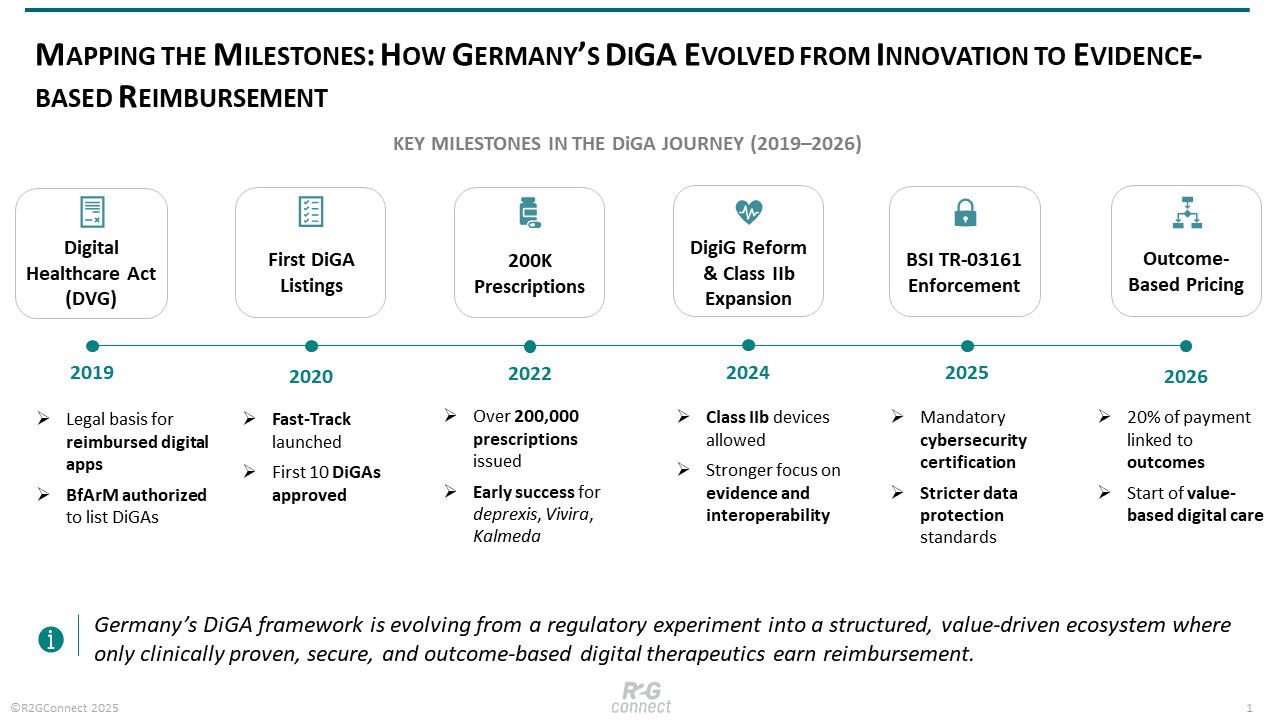
Germany’s Digitale Gesundheitsanwendungen (DiGA) framework has been the global benchmark for reimbursed digital health applications since its launch in 2020. It turned the vision of “apps on prescription” into reality and integrated digital therapeutics directly into the country’s healthcare system.
Five years later, the picture is more complex, yet more promising than ever. With nearly 60 approved DiGAs, over one million prescriptions, and an expanding regulatory scope, DiGA has proven that validated digital therapies can sit alongside drugs and devices in standard care. But the model’s maturity also comes with higher expectations: tighter cybersecurity, outcome-based payments, and stricter clinical proof.
So what does 2025 look like for digital health founders and investors evaluating the DiGA route?
The Current DiGA Landscape
As of mid-2025, around 58 DiGAs are listed in Germany’s official BfArM directory, with 44 permanently approved and 14 provisionally listed while gathering more evidence. Together, they span therapeutic areas from mental health and metabolic disorders to neurology, musculoskeletal care, and women’s health.
Not surprisingly, mental health remains the strongest DiGA category. Apps for depression, anxiety, and insomnia such as Selfapy, deprexis, and HelloBetter represent over 40% of all listings and lead prescription volumes. Musculoskeletal apps like Vivira and Kaia Health follow closely, as do metabolic solutions like Zanadio for obesity and Esysta for diabetes management.
The numbers tell the growth story:
-
Over 239 applications have been submitted since 2020, but only about one in four reached listing status.
-
By the end of 2024, one million DiGA prescriptions had been issued, showing both patient acceptance and growing physician confidence.
-
Statutory insurers reimbursed €234 million in DiGA-related costs between 2020 and 2024.
-
The average reimbursed price per 90-day therapy now stands at around €220–€250 after negotiated price reductions with Germany’s national insurer body (GKV-Spitzenverband).
Yet this growth has not come easily. Roughly half of all applicants withdraw during BfArM’s review, and several high-profile startups have exited the market due to pricing pressures and repayment obligations. Still, the DiGA market is now a sustainable, data-driven component of German healthcare and increasingly a model for other European countries.
Regulatory Tightening and Expansion (2024–2025)
Germany’s Digital Act (DigiG), passed in 2024, brought the most substantial reforms to DiGA since its inception. The goal was to strengthen trust, improve quality, and align digital health innovation with measurable outcomes.
Expanded eligibility
Originally restricted to Class I and IIa medical devices, DiGA is now open to certain Class IIb devices that function under physician supervision. This opens the door for advanced AI-driven diagnostics, rehabilitation tools, and remote monitoring systems.
Mandatory cybersecurity certification
From January 2025, every DiGA must comply with the BSI TR-03161 standard, a comprehensive set of security and anti-tampering requirements issued by Germany’s Federal Office for Information Security. Developers now need third-party certification to prove their app’s resilience against data breaches and manipulation.
While this creates additional costs for startups, it boosts physician and insurer trust and positions DiGA apps among the most secure health applications in the world.
Outcome-based reimbursement
A landmark reform will take effect in 2026, when at least 20% of each DiGA’s price will depend on verified patient outcomes. Reimbursement will increasingly be tied to real-world performance measured through PROMs (patient-reported outcome measures) and engagement data.
This “value-based” shift aligns DiGA pricing with global moves toward results-driven care, pushing digital health startups to prove measurable benefit beyond usability or engagement metrics.
Integration with DiPA and the digital ecosystem
The Digital Care (DiPA) framework, for apps supporting caregivers and long-term care recipients, is now harmonized with DiGA. Both must meet the same BSI security standards and integrate with Germany’s electronic patient record (ePA) system.
This means future digital therapeutics and care tools will coexist in one interoperable ecosystem, a major step toward unified digital reimbursement across health and social care.
The Hard Truth: DiGA’s Barriers for Startups
The DiGA “Fast-Track” remains one of the most rigorous digital health approval systems in the world. Despite its name, it is anything but fast or cheap for startups.
Clinical proof and RCT expectations
Most DiGA approvals require randomized controlled trials to demonstrate “positive healthcare effects.” In fact, 21 of 23 published DiGA studies so far have been RCTs. That is a high bar and a costly one, often exceeding six figures in research spend.
Regulatory and technical complexity
Startups must first obtain an EU CE mark, prove data protection compliance, and now undergo TR-03161 security audits. For small teams without cybersecurity or regulatory experts, this alone can stretch resources to the limit.
Limited physician awareness
Even after approval, many DiGAs face an awareness problem. By 2023, only about one-third of German doctors had ever prescribed a DiGA, and some remain skeptical about clinical value. Education campaigns are improving this, but startups still bear the marketing burden, often without the sales muscle of pharma.
Pricing pressures
The DiGA pricing model can turn a success story into a financial trap. After the first year of free pricing, startups negotiate a final price with insurers, often 50% lower than the launch price, and must retroactively repay the difference.
That was exactly what pushed DiGA pioneers like Aidhere (maker of Zanadio) and Newsenselab (M-sense) into insolvency after arbitration outcomes forced multimillion-euro repayments.
In short, DiGA is not for the faint-hearted. It demands regulatory sophistication, capital endurance, and long-term commitment to evidence generation.
Why It’s Still Worth It
Despite the barriers, the DiGA pathway remains one of the most strategically valuable routes in digital health. Here’s why founders continue to pursue it:
1. Clinical credibility A BfArM listing is a badge of honor, the ISO of digital therapeutics. It signals to payers, clinicians, and investors that your app meets Germany’s gold standard for efficacy, security, and data protection.
2. Nationwide reimbursement access One approval unlocks reimbursement across 80 million insured Germans. Instead of negotiating with over 100 individual insurance funds, startups gain immediate nationwide coverage once listed.
3. Gateway to Europe France, Belgium, and other EU markets are explicitly modeling their own DTx frameworks on DiGA. In 2025, Germany and France signed an agreement to align evaluation standards, a step toward cross-border recognition.
For startups, DiGA success in Germany can serve as a springboard for European expansion.
4. Investor confidence After the initial hype and subsequent skepticism, investors now appear to have a more balanced and realistic view of the potential of DiGA apps. These solutions offer growing and recurring revenue streams — a rare asset in the digital health sector. A DiGA listing also provides credibility, helping companies open doors to new clients and partnerships. This is why DiGA-approved players such as Selfapy and Kaia Health continue to attract strong investor interest, even in today’s cautious funding environment.
5. Market leadership First movers in each DiGA therapeutic niche are now cementing their positions. With years of real-world data, patient feedback, and brand recognition, they are well positioned to become the first DTx choice for other countries and regions.
What’s Next
As Germany enters DiGA’s fifth year, the model is shifting from pilot phase to permanence. The regulatory bar is higher, but so are the rewards. The focus is moving from “getting listed” to “proving real-world value.”
For founders, this means designing apps that drive measurable clinical outcomes, user retention, and interoperability from day one. For investors, it means recognizing that DiGA approval is not just a regulatory checkbox but a strategic moat that differentiates serious digital therapeutics from wellness plays.
Ultimately, DiGA’s evolution proves one thing: Europe’s digital health revolution is being built on evidence, not hype. And Germany remains its testing ground.
Explore Current R2GConnect Deals Supporting DiGA Builders
Interested in entering Germany’s reimbursement track or supporting startups already navigating it?
Deal 1: Create Your DiGA — Free Development Kick Off (Bornholdt Lee GmbH) Your first step toward a lovable and compliant digital health solution. In this free 180-minute workshop, the Bornholdt Lee team helps transform your concept into a roadmap for a DiGA-ready prototype.
Focus areas include:
- Turning your use case into functional features and user flows
- Shaping technical architecture with compliance by design
- Aligning usability, security, and regulatory requirements early
- Defining success metrics for patient benefit and product performance
Outcome: a clear development plan that makes your DiGA lovable, safe, and ready to grow.
Deal 2: Free Micro Consulting for DiGA, DTx & Medical Software (BAYOOMED GmbH) _Have a specific technical or regulatory question? _
BayooMED’s micro consulting service offers quick, free, and confidential expert advice on DiGA, DTx, and medical software topics including MDR, IVDR, FDA, QMS, cybersecurity, verification, and usability.
R2GConnect connects digital health innovators, investors, and regulatory partners shaping the future of European healthcare. Explore these and more active opportunities at R2GConnect.com.