
Longevity is not one market; it’s a mosaic of different monetization strategies, each shaped by regulation, consumer behavior, and partnerships with healthcare stakeholders. Here’s how the five key longevity categories are building revenue:
1. Biomarker & Aging Clocks
Startups here measure biological age using epigenetic, proteomic, glycan, or other markers.
Business models & price ranges:
- B2C testing kits: At‑home kits typically cost $200–$400 per test, with some consumers repeating tests once or twice per year. General estimates place epigenetic tests at $300–$500 and glycan‑based tests at roughly $350–$500.
- Subscription memberships: Many firms offer longitudinal tracking and personalised advice for $100–$200 per month; an annual membership of around $129 per month can include quarterly tests and supplements.
- B2B licensing & data platforms: Some providers license their clocks to wellness companies or pharma for tens of thousands of dollars per year.
Example: Tally Health sells epigenetic‑age kits for about $229 per test or an annual membership of around $129/month. GlycanAge charges roughly $400 per test with consultation. Other entrants, such as Zymo Research (DNAge) and Deep Longevity, serve both consumers and enterprise clients.
2. Preventive Health & Lifestyle Optimisation
This busy category combines diagnostics, digital coaching, and personalised nutrition or supplements into a holistic health program.
Business models & price ranges:
- Membership subscriptions: Consumers typically pay $50–$200 per month for programmes that bundle blood tests, coaching, and supplements. One programme charges $499 per year (~$42/month) for two rounds of testing, while another costs around $129 per month after a $349–$549 initial workup.
- Freemium or app‑based coaching: Some apps start free and upsell personalised glucose monitoring or fitness coaching at $5–$30/month.
- Telehealth pharmacy & supplements: Some telehealth services prescribe off‑label longevity drugs (e.g., rapamycin or metformin) through direct‑pay telemedicine; rapamycin therapy starts around $40–$65/month. Supplement subscriptions range from $79 to $149 per month.
- Corporate wellness and insurer partnerships: Some platforms sell bulk packages to employers or insurers at $20k–$200k per contract.
Example: Function Health offers an annual membership that covers more than 100 lab tests and physician insights. Lifeforce combines quarterly blood panels, doctor consultations, and customised nutraceuticals for $129/month after an initial assessment. AgelessRx provides longevity prescriptions like rapamycin ($40–$65/month) via telehealth.
3. Early Detection & Screening
These companies use imaging and lab technologies to catch diseases earlier, generating revenue through high‑ticket scans and partnerships with health systems.
Business models & price ranges:
- One‑off diagnostic services: Full‑body MRI scans cost around $2,500 per session. Another provider offers an AI‑driven scan plus doctor consultation for ~ £299 (≈$370), aiming for volume through accessible pricing.
- At‑home test kits & devices: Smartphone urine test kits are sold through B2B2C deals (~$30 per test), while some countertop blood analysers use a razor‑and‑blades model where cartridges cost $50–$75 each; users might run multiple tests annually.
- Enterprise SaaS & partnerships: Software platforms license their systems to clinics; biopharma or biobank collaborations can generate contracts worth $100k–$1M.
Example: NEKO Health runs affordable full‑body scanning clinics at ~£299 per scan. Prenuvo offers premium MRI scans ($2,499–$3,999) targeting affluent consumers and employer wellness programmes. SiPhox Health markets a countertop blood analyser with single‑use cartridges priced $50–$75. Healthy.io and Loovi work with insurers and employers to distribute home kits.
4. Therapeutic Discovery & Geroprotectors
This biotech‑heavy category uses AI and big data to discover drugs that target ageing pathways. Rather than selling to consumers, these startups monetise through deals with pharmaceutical companies.
Business models & price ranges:
- Pharma licensing deals: Firms sign discovery partnerships that pay $5 M–$50 M upfront with milestones worth hundreds of millions and mid‑single‑digit to low‑double‑digit royalties.
- Joint ventures & co‑development: Startups may co‑fund clinical trials, sharing risk and future revenue; such deals can reach $10 M–$100 M+.
- Data subscriptions & consulting: Some companies sell access to proprietary datasets and analytics to VCs, governments, or pharma at five‑ or six‑figure annual rates.
- Decentralised data sharing: Projects like Rejuve.AI reward contributors with tokens that can be monetised if the underlying IP is licensed.
Example: Insilico Medicine has inked deals with pharma partners worth up to $550 M+ and another collaboration totalling $1.2 B in potential milestones. AgeXtend and BioAge discover geroprotective compounds and partner with larger drug companies, while Aging Analytics Agency and Longevity.AI sell market intelligence to investors.
5. At‑Home Monitoring & Real‑Time Vitals
Wearables and connected devices gather continuous health data, generating revenue through hardware sales, subscription software, and insurer reimbursements.
Business models & price ranges:
- Hardware + SaaS: Devices typically cost $200–$800, depending on sophistication. For example, a seizure‑detection wearable sells for about $249 and requires a subscription; monthly plans range from under $10 to $45, depending on features. Digital stethoscopes run roughly $300, and their AI membership costs $119.99 per year or $12.99 monthly. Another medical‑grade wristband retails for $800 and includes a pro software fee for clinicians.
- B2B remote monitoring programmes: Remote monitoring providers supply kits of connected devices to telemedicine programmes; healthcare providers can bill Medicare using Remote Patient Monitoring codes that reimburse around $120 per patient per month. Vendors take a share of this reimbursement for equipment and software.
- Enterprise contracts: Hospitals and insurers may sign six‑ or seven‑figure deals for large‑scale deployment of monitoring solutions.
Example: Eko Health sells a digital stethoscope (~$300) and charges an Eko+ subscription ($119/year or $12.99/month) for AI‑powered AFib and murmur detection. Empatica provides the Embrace2 watch ($249) with tiered subscription plans under $10, ~$20, and ~$45 per month. Tellihealth supplies remote vital sign kits to clinicians who bill RPM codes that reimburse around $120 per patient per month. CardiacSense and Hexoskin sell advanced wearables via bulk contracts with health systems.
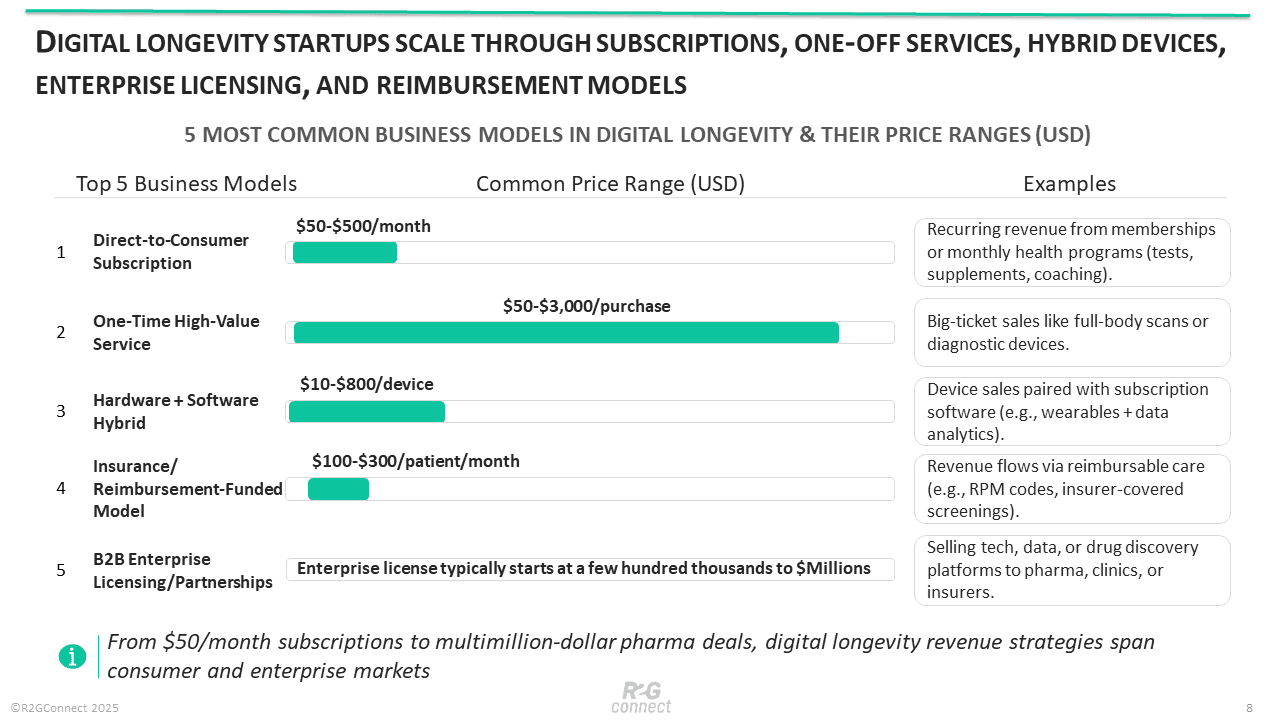
Top 5 Business Models in Digital Longevity (Most Common)
Across all categories, a few business model archetypes have emerged as the most common in digital longevity: 1. Direct-to-Consumer Subscription: Recurring revenue from individual users via memberships or monthly plans. Examples: biomarker testing subscriptions (e.g., Tally Health), preventive health programs (Function Health, Lifeforce). This model offers steady cash flow and high user engagement, but requires strong retention and value to avoid churn. Typical price range:
- Memberships or ongoing health programs: $50–$200 per month
- Some programs: $499 per year (~$42/month)
- Initial assessments/tests: $349–$549 one-time
- Supplement subscriptions: $79–$149 per month
2. One-Time High-Value Service: Revenue from one-off sales of big-ticket health services or devices. Examples: full-body scans (Prenuvo’s $2.5K MRI, NEKO’s ~ $370 scan), or selling an at-home device outright. Profitable per transaction, but companies must continually acquire new customers or introduce new offerings to grow. Typical price range:
- Full-body MRI scans: ~ $2,500 per session
- AI-driven body scans: £299 (~$370) per session
- At-home tests (razor-blade model): $50–$75 per cartridge
- Other diagnostic kits: ~ $30 per test
3. Hardware + Software Hybrid: A device-plus-subscription model where a company sells a medical device and also charges for accompanying digital services. Examples: Eko’s stethoscope and AI platform fee, Empatica’s watch with monthly monitoring plans. This creates dual revenue streams (product sales and SaaS) and can build user lock-in, but requires excellence in both hardware and software execution. Typical price range:
- Devices (wearables, stethoscopes, monitors): **$200–$800. **Example: seizure-detection watch at $249, stethoscopes ~ $300, clinical-grade wristband ~ $800
- SaaS subscriptions: $10–$45 per month
- AI/analysis memberships: $119/year (~$12.99/month)
4. Insurance/Reimbursement-Funded Model: Generating revenue through healthcare payers by fitting into reimbursable care models. Examples: remote monitoring companies enrolling patients under Medicare/insurance programs (providers get ~ $120/month per patient from RPM codes, sharing value with the tech supplier). Also, early detection tools are partnering with insurers for covered preventive screenings. This model can unlock mass adoption by reducing consumer cost, but startups must navigate regulatory and clinical validation hurdles to win payer trust. Typical price range:
- Remote patient monitoring reimbursement: ~$120 per patient per month (U.S. Medicare/insurance codes)
- Hospital/insurer enterprise contracts: six- or seven-figure deals
5. B2B Enterprise Licensing/Partnerships: Monetizing by selling technology or data insights to other businesses (pharma, clinics, insurers). Examples: AI drug discovery firms licensing compounds or platforms (Insilico’s $500M+ pharma deals), or software like LongevityEHR sold to clinics. These deals can be large and validate the tech, though sales cycles are longer and dependent on proving ROI to partners. Typical price range:
- Pharma licensing deals: $5M–$50M upfront, with hundreds of millions in milestone payments
- Joint ventures: $10M–$100M+
- Data subscriptions & consulting: five- or six-figure annual contracts
- Decentralized/token models: variable, tied to IP licensing
Each of these models can overlap (many startups use a hybrid of two or more), but they represent the primary avenues by which digital longevity ventures are turning innovation into income. As the longevity sector continues its rapid growth, startups that align the right model with their solution – and can demonstrate both health impact and economic value – will be best positioned to thrive in this emerging industry. Are you building the future of longevity? Join our next Digital Longevity event on Sep 23 at 4:30 PM CET
- For startups, apply here to pitch in front of investors: https://www.r2gconnect.com/briefing-details?recordId=rec3MERP95KICw5XU&ref=R2GCArt&type=brief
- For investors, register here to meet the hidden champions: https://us02web.zoom.us/meeting/register/_nTf4kwBRk2Ai8oediGzxQ Contact us for more information or to discuss your longevity solution.