
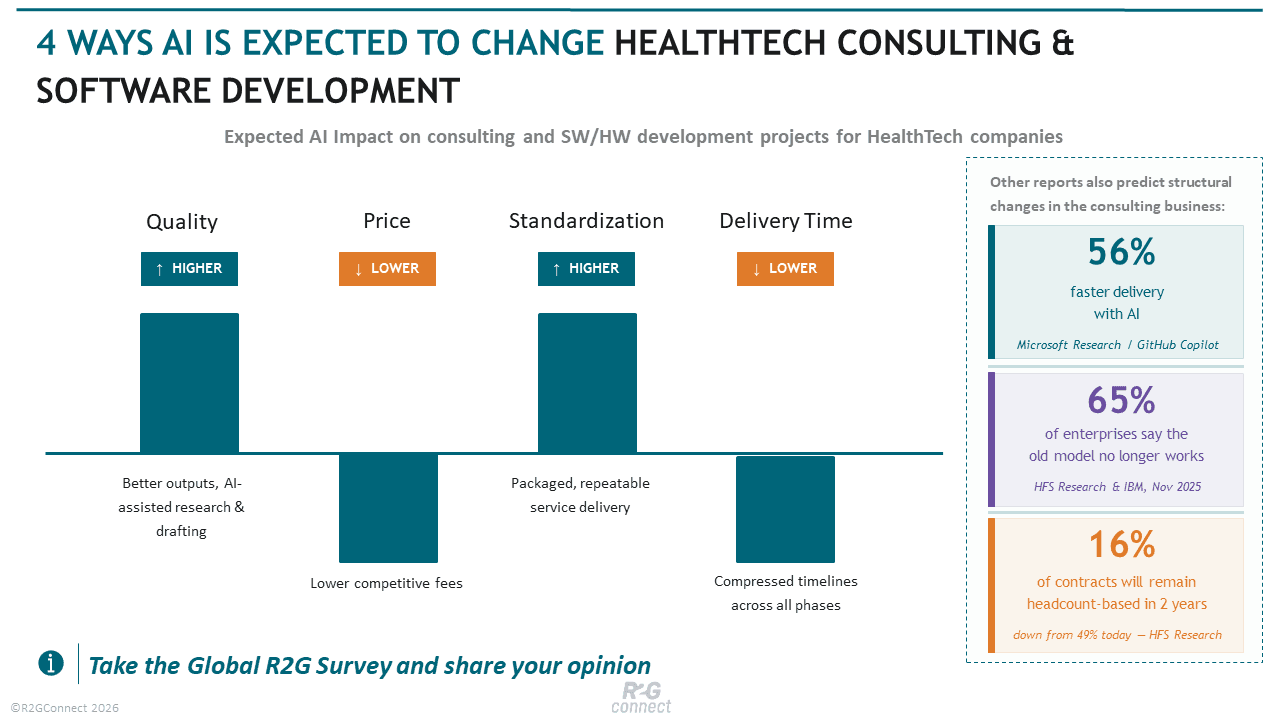
Time-and-materials billing made sense when consultant hours were the primary input. AI has broken that logic: coding tasks completed up to 56% faster¹, analytical deliverables compressed from weeks to days, smaller senior teams replacing large generalist pyramids. The effort-to-output ratio has shifted enough that buyers no longer have to accept opaque hourly billing.
The market data backs this up: 65% of enterprise executives² say traditional consulting models no longer deliver value, and headcount-based contracts are expected to fall from 49% to just 16%² of the market within two years. For healthtech startups, this creates a real opening.
Four Changes That Will Matter for Healthtech Startups
AI is beginning to reshape how healthtech consultants and software and hardware developers design, deliver, and price their services. Early signals point to four structural shifts that startups should be aware of:
1.Projects are getting shorter Workstreams that previously took months — such as regulatory strategy development, market and competitor due diligence, or usability validation — are increasingly being compressed into weeks. AI tools can generate research outputs, draft documentation, and structure analyses within hours. Human experts will focus more on validation, contextualization, and quality assurance rather than primary content creation.
2.Pricing is declining and becoming outcome-linked As AI improves productivity, service providers will need to pass part of these efficiency gains on to clients to remain competitive. This is accelerating the shift toward outcome-based pricing models. Instead of purely time- and resource-based billing, projects will increasingly combine a base fee with performance-linked components tied to measurable milestones or results.
3.AI is driving the standardization of service offerings AI enables firms to codify repeatable expertise into clearly defined service products. Resource requirements become more predictable, allowing providers to offer standardized packages with transparent deliverables, timelines, and pricing. Healthtech startups will be able to “buy off the shelf” services such as MVP development, market and competitive assessments, or GDPR compliance reviews — reducing uncertainty in planning and budgeting.
4. AI is expected to improve the quality and consistency of deliverables The use of AI tools is likely to enhance both the quality and reliability of outputs across healthtech consulting and product development projects. AI can process larger volumes of scientific literature, regulatory guidance, market data, and user feedback than human teams alone, reducing the risk of overlooked insights or analytical bias. In addition, AI-supported workflows enable more structured documentation, automated testing, continuous validation, and faster iteration cycles. As a result, deliverables are expected to become more evidence-based, standardized, and reproducible. However, achieving higher quality will depend on effective human oversight, domain expertise, and the ability of providers to integrate AI outputs into robust quality assurance processes.
AI is set to transform how consulting, software, and hardware services are delivered and sold — and the timing for these changes is now. Many founders note that current collaboration models often lack pricing transparency and don’t align with the financial realities of early-stage companies.
To better understand this gap, R2GConnect has launched the HealthTech Startup Growth Support Survey, which explores preferred pricing models, acceptable project budgets, retainer limits, interest in equity-based arrangements, and appetite for AI-supported services.
The survey takes just five minutes to complete, is fully anonymous, and participants receive access to aggregated results — providing valuable benchmarking insights against peer companies.
➤ Participate in the survey: click here
Sources ¹ Peng et al., “The Impact of AI on Developer Productivity: Evidence from GitHub Copilot”, Microsoft Research — https://www.microsoft.com/en-us/research/publication/the-impact-of-ai-on-developer-productivity-evidence-from-github-copilot/ ² HFS Research & IBM, “AI-Powered Consulting Forces Reckoning: 65% of Enterprises Say Traditional Models No Longer Deliver Value” (November 2025) — https://www.prnewswire.com/news-releases/ai-powered-consulting-forces-reckoning-65-of-enterprises-say-traditional-models-no-longer-deliver-value-302610655.html ³ McKinsey Healthcare Practice, “Generative AI in Healthcare: Current Trends and Future Outlook” (March 2025) — https://www.mckinsey.com/industries/healthcare/our-insights/generative-ai-in-healthcare-current-trends-and-future-outlook