
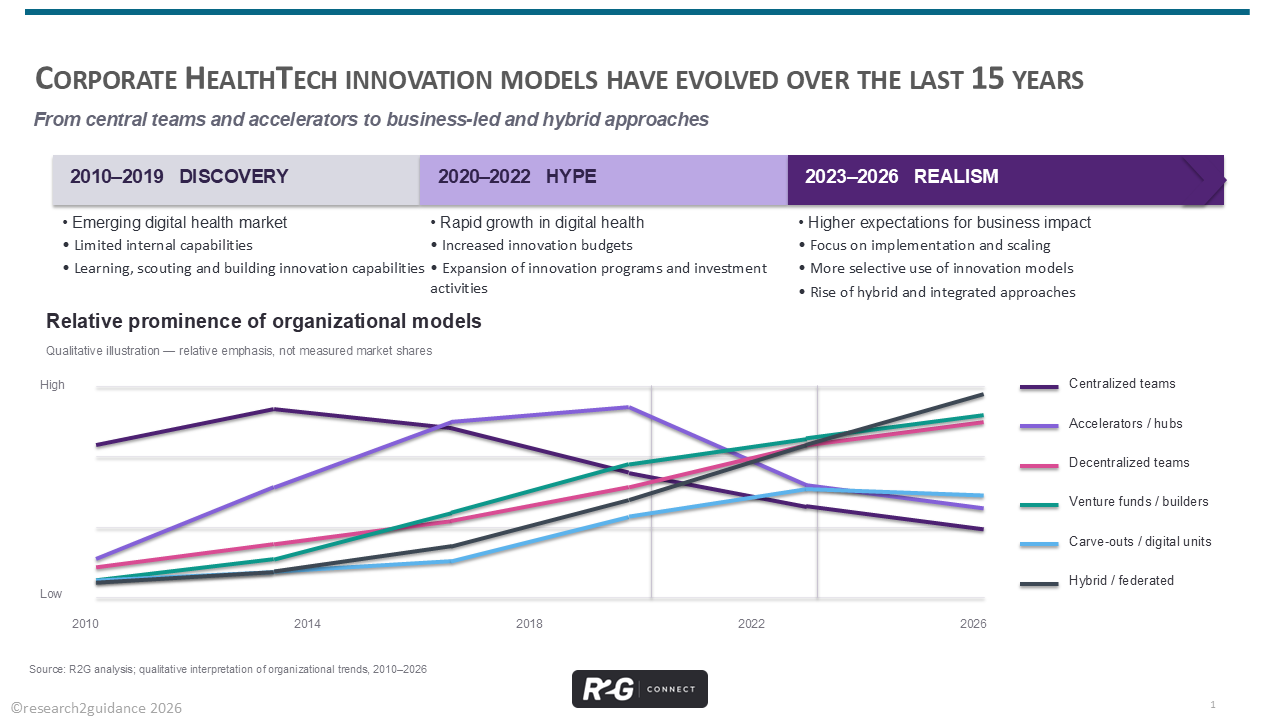
Over the past 15 years, pharmaceutical companies, MedTech manufacturers and hospital groups have experimented with centralized innovation teams, accelerators, incubators, venture funds and dedicated digital health businesses. Some have generated hundreds of startup relationships, while others have focused on developing and commercializing a smaller number of solutions. But which organizational model delivers the best results?
Corporate innovation has gone through three distinct phases The way healthcare companies organize innovation has changed significantly since 2010. In the early days of digital health, there were relatively few mature solutions and limited digital expertise within established healthcare organizations. Companies needed to understand emerging technologies, identify promising startups and develop new capabilities.
The discovery phase (approximately 2010–2019) therefore saw the emergence of centralized digital health teams, innovation hubs, incubators and corporate accelerators. During the hype phase (2020–2022), digital health gained strategic importance. The pandemic accelerated adoption of telehealth, remote monitoring and digital patient services. Healthcare corporations expanded their innovation activities, invested in startups and experimented with venture building, digital marketplaces and dedicated digital health businesses.
Since 2023, a more pragmatic realism phase has emerged. Innovation budgets face closer scrutiny, and management teams increasingly demand measurable business outcomes. The focus is shifting from discovering technologies and supporting startups to selecting, implementing and scaling solutions that address specific business needs. This evolution has not produced one dominant organizational structure. Instead, companies have developed different models depending on their strategic objectives.
Five approaches to organizing corporate innovation Although individual companies use different names and governance structures, five broad approaches can be distinguished.
- Centralized innovation teams Central teams coordinate innovation strategy, monitor technology trends and manage external partnerships across business units. Their main advantage is efficiency: expertise, market intelligence and scouting capabilities are concentrated in one organization. The challenge is ensuring that business units take responsibility for implementation.
- Decentralized innovation teams Innovation responsibilities are embedded within therapeutic areas, product divisions or hospital departments. These teams understand operational needs and can connect projects directly to commercial or clinical priorities. However, their limited resources and fragmented market visibility can result in duplicated efforts and missed opportunities.
- Innovation hubs, incubators and accelerators These structures focus on identifying technologies, working with startups, developing new solutions and fostering entrepreneurial culture. They have been particularly useful for building innovation capabilities. However, creating startup relationships does not necessarily translate into successful product launches or sustained adoption.
- Venture funds, venture builders and independent digital health businesses Corporate venture capital units invest in emerging technologies, while venture builders and carve-outs develop businesses with greater operational independence. These models can be appropriate when companies seek new revenue streams, ownership of strategic technologies or opportunities beyond their existing core business. They generally require more specialized capabilities and a different risk appetite than conventional partnership programs.
- Federated or hybrid innovation models Hybrid approaches combine central innovation coordination with decentralized business ownership. Central teams provide strategic direction, market intelligence and standardized processes. Business units identify needs, sponsor projects and take responsibility for implementation. External partners may support specialized activities such as technology scouting, solution evaluation and partnership development.
The objective is to combine the advantages of centralized expertise with the accountability of decentralized execution.
What can we learn from leading healthcare companies? Major healthcare corporations illustrate how different models have evolved. Bayer's G4A started in 2013 with a focus on funding mobile health applications. Its activities subsequently evolved toward more targeted collaboration with digital health companies relevant to Bayer's businesses.
Johnson & Johnson's JLABS developed a geographically distributed innovation ecosystem, providing early-stage companies with access to infrastructure, expertise and industry networks. Novartis Biome, launched in 2018, focused on connecting digital health innovators with business needs and supporting the development and validation of new solutions.
Roche has experimented with several approaches, including Startup Creasphere and venture-building activities, reflecting the different needs of its pharmaceutical and diagnostics businesses. Hospitals have developed their own organizational models. Mayo Clinic Platform Accelerate supports health technology companies in developing and validating solutions, while UPMC Enterprises combines investment, technology development and commercialization. These examples demonstrate that corporate innovation models are not mutually exclusive. Large organizations frequently operate several structures simultaneously, serving different innovation objectives.
Which model actually performs best? A study of innovation activities across 14 major pharmaceutical companies identified 102 innovation centers, illustrating the scale and diversity of corporate innovation infrastructure. However, comparing their performance is difficult. Accelerators may be successful at attracting startups and building innovation networks. Venture funds may generate financial returns or access to strategic technologies. Business-unit teams may implement fewer projects but achieve stronger alignment with operational requirements.
These outcomes cannot be evaluated using a single metric. Our research reached a similar conclusion in its analysis of 11 HealthTech organizational archetypes: no single model demonstrated high impact across all four evaluated dimensions—partnerships, solution launches, usage and cultural change.
This is an important distinction. The model generating the most partnerships is not necessarily the one generating the greatest commercial impact. A growing body of research also highlights the difficulties of maintaining corporate–startup collaboration after accelerator programs end. Relationships established during a program may not develop into commercial partnerships without business-unit sponsorship, implementation budgets and clear decision-making responsibilities.
The decisive factor is therefore not only the organizational structure but also how innovation activities connect with the company's core business.
Is a hybrid approach the answer? For many established healthcare organizations, a federated model offers a compelling organizational direction. It allows companies to maintain a central overview of innovation opportunities while keeping project ownership close to the business. A central team can coordinate innovation roadmaps, identify relevant technology segments, manage scouting activities and maintain a company-wide portfolio. Business units or clinical departments can define requirements, evaluate solutions, allocate budgets and manage implementation. Specialized external partners can complement internal resources, particularly where market coverage, technology expertise or scouting capacity is limited. However, a hybrid structure is not automatically superior. Without clear responsibilities, it can create additional coordination costs and slower decisions. Its effectiveness depends on well-defined governance, transparent project selection and explicit ownership of implementation.
The next phase: From innovation activity to business impact Healthcare companies should assess their innovation models against three questions:
- Strategic fit: Does the organizational structure support the company's innovation priorities?
- Execution capability: Can the organization move efficiently from identifying opportunities to implementing solutions?
- Measurable impact: Are results evaluated through business outcomes rather than startup contacts, events or pilot numbers? The answers will differ between a pharmaceutical company seeking medication companion solutions, a MedTech manufacturer building connected products and a hospital group implementing AI-based workflow automation. There is no universally best organizational model. The most effective approach is the one that connects external innovation with internal business ownership—and can demonstrate that the resulting solutions deliver value.
From Innovation Strategy to HealthTech Partnerships. Research2Guidance supports healthcare organizations in designing and managing HealthTech innovation programs, combining strategic expertise with technology scouting and partnership development through R2GConnect. https://www.r2gconnect.com/innovation-scouting
Sources and further reading
- Research2Guidance (2024): How to Best Organize a HealthTech Business? — Analysis of 11 organizational archetypes and their performance.
- Driving health transformation: big pharma's innovation labs revolution (2025), Health Research Policy and Systems — Analysis of innovation centers and activities across major pharmaceutical companies.
- Kramer & Kanbach (2023), International Entrepreneurship and Management Journal — Research on corporate accelerators and post-program collaboration.
- Mayo Clinic Platform: Accelerate — Official program information.
- Roche: Startup Creasphere — Corporate innovation initiative.