For years, Real-World Evidence (RWE) was hailed as the missing link between clinical trials and real-world impact. It promised faster studies, broader patient inclusion, and better post-market insights — but progress was often slow. Data fragmentation, manual analytics, and regulatory uncertainty held back the potential.
That’s now changing.
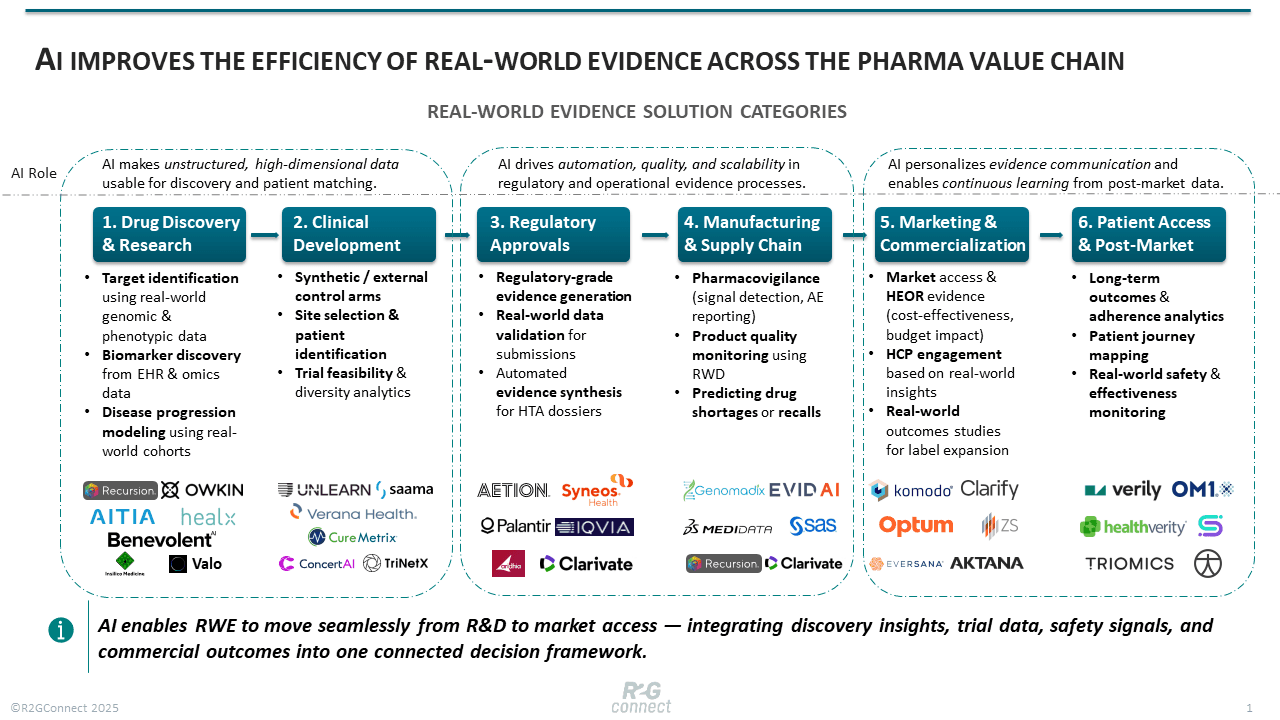
Artificial intelligence (AI) is no longer just a buzzword in RWE; it’s becoming a structural enabler embedded throughout the pharmaceutical value chain. By integrating real-world data (RWD) from EHRs, claims, genomics, wearables, and patient apps, AI-driven RWE solutions are helping pharma companies make faster, more confident decisions — from discovery to commercialization.
1. Drug Discovery & Research: From Hypotheses to Data-Driven Targets
RWE now extends upstream into the earliest stage of pharma R&D. AI models analyze vast genomic, phenotypic, and clinical datasets to uncover novel disease pathways and biomarkers that were invisible to traditional analytics.
Multi-modal AI combines omics, imaging, and EHR data to predict disease progression and identify patient subtypes — accelerating the selection of viable targets for precision medicine.
- AI Roles: Predictive analytics, multimodal data fusion, deep learning for biomarker prediction
- Representative Solutions: Owkin, Aitia, BenevolentAI, Valo Health, Healx, Insilico Medicine
- Impact: AI enables hypothesis generation grounded in real-world biology, reducing early-stage attrition and guiding more targeted preclinical validation.
2. Clinical Development: Smarter Trials and Synthetic Control Arms
AI-enhanced RWE platforms are transforming clinical operations. By harmonizing and analyzing diverse RWD sources, AI helps design smarter protocols, simulate control arms, and optimize site selection and recruitment.
Machine learning models identify eligible and diverse patient cohorts, while natural language processing (NLP) parses unstructured EHR notes to find potential participants.
- AI Roles: NLP for EHR parsing, patient similarity modeling, predictive analytics for recruitment
- Representative Solutions: Unlearn.AI, Verana Health, ConcertAI, CureMetrix, Saama Technologies, TriNetX
- Impact: Reduced trial timelines, higher enrollment diversity, and lower dependence on placebo groups — all while maintaining regulatory credibility.
3. Regulatory Approvals: Evidence Generation at Submission Speed
AI is improving the way pharma companies generate and package regulatory-grade evidence.
Generative models automate parts of value dossier creation and submission documentation, while advanced analytics platforms ensure transparency, reproducibility, and traceability across datasets used for regulatory filings.
- AI Roles: Generative AI for dossier drafting, knowledge graph linking, explainable ML for regulatory analytics
- Representative Solutions: Aetion, Syneos Health - Data Science Hub, Palantir Foundry for Life Sciences, IQVIA RWE Platform, Aridhia DRE, Cortellis Evidence (Clarivate)
- Impact: Faster submission readiness, higher evidence quality, and greater regulatory confidence in RWD-derived results.
4. Manufacturing & Supply Chain: Real-Time Quality and Safety Insights
Beyond R&D, AI-driven RWE supports manufacturing optimization and pharmacovigilance.
Machine learning systems detect anomalies in production data and automate adverse event (AE) monitoring from clinical databases and post-market sources. NLP models scan literature and spontaneous reports for early signals of safety issues.
- AI Roles: NLP-based signal detection, anomaly detection, predictive quality analytics
- Representative Solutions: Genomadix, Medidata Detect (Dassault Systèmes), Drug Safety Triager (by Clarivate), EvidScience, SAS Life Science Analytics Framework, Recursion
- Impact: Proactive quality assurance and safety monitoring lower operational risks and support continuous regulatory compliance.
5. Market Access & Commercialization: Evidence That Speaks Payer Language
RWE plays a pivotal role in demonstrating value to payers and providers. AI tools simulate cost-effectiveness and budget-impact models, extract payer-relevant outcomes from large datasets, and generate health-economic narratives automatically using large language models (LLMs).
In parallel, commercial teams use AI to map patient journeys and predict therapy adherence and switching patterns.
- AI Roles: ML-based HEOR simulation, LLM-based report generation, predictive adherence modeling.
- Representative Solutions: Komodo Health, Eversana Intelligence, Clarify Health, ZS RWE Navigator, Aktana, Optum Life Sciences.
- Impact: AI turns real-world insights into actionable value stories that improve access, reimbursement, and lifecycle management strategies.
6. Patient Access & Post-Market: Continuous Outcomes and Real-World Safety
After launch, the real work begins, ensuring that patients benefit as intended and that therapies remain safe and effective in real-world settings.
AI-driven RWE solutions now link longitudinal data from EHRs, claims, registries, wearables, and digital therapeutics to build a 360° view of patient outcomes. Machine learning models predict adherence risks, identify long-term safety signals, and track comparative effectiveness across populations and treatment pathways. Generative AI also assists in summarizing post-market safety reports and communicating findings to regulators and healthcare partners.
- AI Roles: Predictive modeling for outcomes, causal inference, temporal analytics for adherence, LLM-based summarization of safety data.
- Representative Solutions: Verily Evidence Generation Platform, OM1, HealthVerity, Huma, Sensyne Health, Triomics.
- Impact: Pharma can move from reactive reporting to proactive evidence generation — monitoring real-world outcomes, refining treatment guidance, and sustaining payer trust through continuous, data-driven validation.
The Future of AI-Enabled RWE
AI’s integration into RWE is progressing from pilot to scalable practice.
While regulatory adoption remains selective, AI is now integral to evidence generation, pharmacovigilance, and population analytics.
As models become more transparent and interoperable, AI will enhance the reliability and accessibility of real-world insights, supporting data-driven decision-making across the product lifecycle, from R&D to patient outcomes.
Join the Next Wave of RWE Innovation
If you are developing an AI-powered RWE or advanced analytics solution, this is the time to engage with leading pharmaceutical partners.
R2GConnect has launched a new Pharma Channel Open Call: “Real-World Evidence (RWE) Platforms and Advanced Analytics for Pharma.”
This opportunity invites HealthTech startups and scaleups to present their solutions directly to pharma companies seeking innovative approaches to evidence generation, outcomes research, and post-market analytics.
Apply before 12 December 2025 to gain visibility, pitch your solution, and explore co-development or pilot opportunities. 👉 Join the R2GConnect Pharma Channel: Real-World Evidence & Advanced Analytics