For years, Remote Patient Monitoring (RPM) has promised to transform care, but often fell short. Could AI finally be the turning point that makes RPM indispensable in modern healthcare?
What RPM Solutions Are For
Remote Patient Monitoring (RPM) refers to technologies that connect patients with healthcare providers beyond the clinic, while continuously monitoring vital signs, treatment progress, and disease management. The “remote” element ensures patients stay connected to doctors wherever they are; the “monitoring” element enables ongoing tracking of health data in real time.
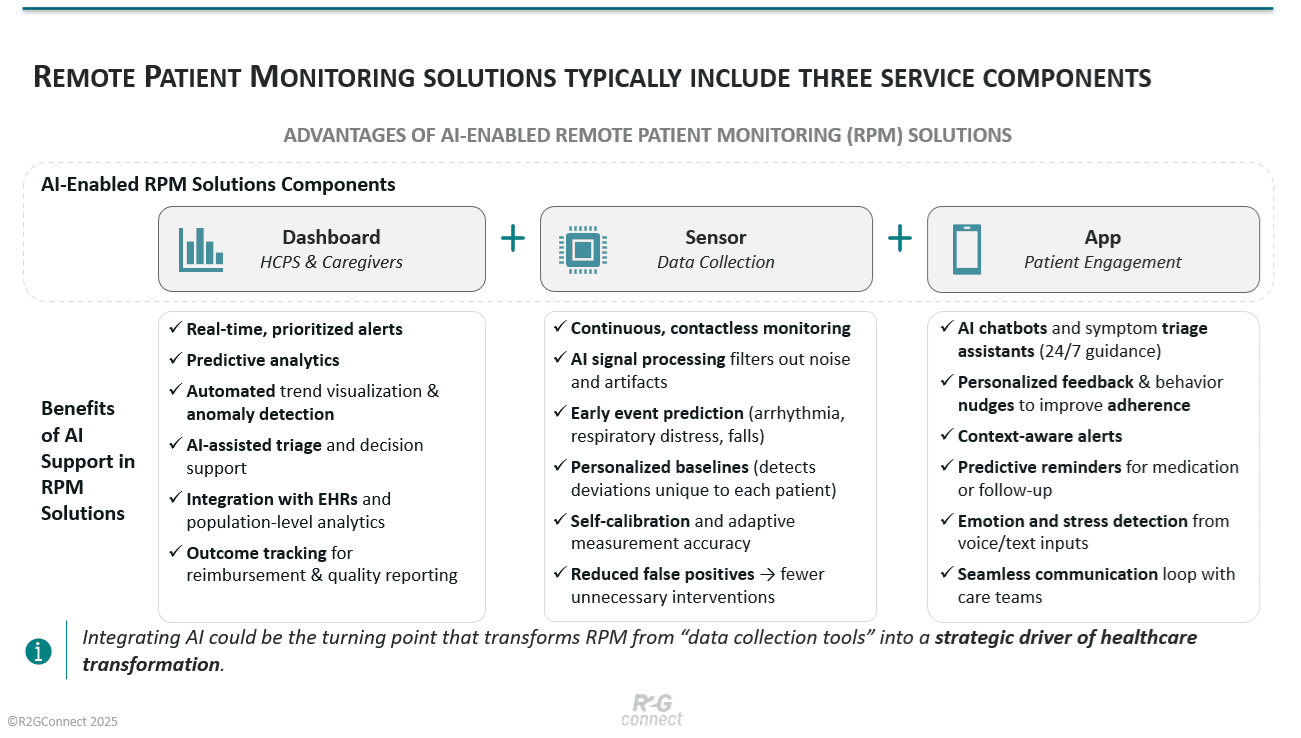
Artificial Intelligence (AI) is transforming RPM from simple device-based data collection into dynamic systems that analyze, predict, and personalize care. Instead of merely transferring data, AI-enabled RPM solutions can detect anomalies, predict complications, recommend interventions, and engage patients in proactive ways.
This integration of AI has opened the door for new business models, stronger reimbursement alignment, and a renewed wave of investor interest.
AI-Enabled Use Cases in RPM
AI has expanded RPM beyond monitoring devices to full care ecosystems. Below, the use cases are organized into three key categories that highlight how RPM fulfills both the Remote and Monitoring criteria.
1. RPM Solutions for Remote Monitoring & Data Collection Using AI AI algorithms continuously analyze vital signs such as heart rate, blood pressure, and oxygen saturation to detect subtle changes before they escalate into crises. Machine learning models trained on large datasets can flag arrhythmias, hypoxemia, or sepsis risk earlier than human observation.
These solutions collect patient data outside the hospital and apply AI to identify patterns or risks earlier than traditional methods. They are particularly valuable in managing chronic diseases such as diabetes, hypertension, and cardiac care, where continuous monitoring is essential.
Impact: From recording vitals to predicting crises.
Examples:
- Implicity (France): AI-powered cardiac device monitoring that integrates with implantable defibrillators and pacemakers, delivering dashboards and predictive alerts to cardiologists.
- iRhythm (US): Zio patch and analytics dashboard analyzing ECG data to detect arrhythmias with AI-assisted reporting for clinicians.
- Dozee (India): Contactless bedside sensor with AI algorithms for continuous heart and respiratory monitoring, enabling hospital-at-home deployments.
- Biobeat (Israel): Wearable RPM solution tracking blood pressure, oxygen saturation, and heart rate with clinician dashboards for real-time oversight.
- Onera Health (Netherlands): Wireless sleep diagnostics with AI analytics feeding HCP dashboards, helping clinicians manage sleep disorders remotely.
- Binah.ai (Israel): Video-based vital sign monitoring (via smartphone camera) with clinician dashboards powered by AI anomaly detection.
Why it matters: These solutions turn passive measurements into predictive insights, aligning well with reimbursement frameworks in the U.S. (Medicare CPT codes) and EU (DiGA/ETAPES programs). Subscription + device business models create recurring revenues that attract investors.
2. RPM Solutions for Clinical Decision Support & Analytics Here, RPM platforms aggregate multimodal data (wearables, labs, imaging, and EHR inputs) into predictive dashboards for clinicians. AI helps identify high-risk patients, prioritize interventions, and reduce costly hospitalizations.
Impact: From fragmented data to actionable insights.
Examples:
- Current Health (UK/US): AI-driven hospital-at-home platform that stratifies risk and guides timely interventions through a unified provider dashboard.
- Biofourmis (US/Singapore): Uses AI to create digital “physiological twins” that adapt therapy recommendations for each patient in cardiology, oncology, and post-acute care.
- Myia Health (US): RPM platform that collects continuous physiological data (from wearables, sensors, and patient-reported outcomes) and aggregates it into dashboards where AI stratifies risk and helps clinicians prioritize interventions.
- VitalConnect (US): Wearable biosensors streaming continuous vitals into AI dashboards that support clinical decision-making in cardiology and post-acute care.
Why it matters: These solutions reduce costs by enabling predictive, proactive care. They hold high valuation potential due to differentiation, scalability, and integration with health systems. For providers, they improve operational efficiency and meet payer demands for value-based care.
3. RPM Solutions for AI-Supported Patient Engagement & Communication Patient adherence and engagement are critical to RPM success. AI enables platforms to deliver personalized nudges, virtual assistants, and automated triage, ensuring patients stay on therapy and providers are alerted only when needed.
Impact: From reminders to intelligent companionship.
Examples:
- CarePredict (US): AI-enabled wearable for seniors that tracks functional decline and alerts providers through dashboards when risks such as falls or malnutrition appear.
- GluCare.Health (UAE): Hybrid AI-enabled clinic and RPM platform that lets providers track diabetes patients’ glucose, lifestyle behaviors, and adherence in real time.
- Huma (UK): Combines remote monitoring (vitals, symptoms, recovery progress) with AI-powered communication and patient engagement. It has HCP dashboards and is widely used in post-acute recovery, chronic disease, and clinical trials.
- Somatix (US/Israel): AI gesture recognition tracking patient adherence and risky behaviors.
- Feel Therapeutics/Feel RPM (Greece/US): Wearable-driven AI platform monitoring stress and mood with HCP dashboards and weekly 15-minute remote data-driven sessions with a designated licensed therapist with expertise in CBT.
Why it matters: By reducing non-adherence (a $300B problem in the U.S. alone), these tools directly improve patient outcomes and generate measurable ROI. They also integrate naturally into provider workflows, making adoption easier.
Why AI Could Be the Turning Point for RPM
Remote Patient Monitoring (RPM) has had a turbulent journey: a niche before 2020, a COVID-era boom, then post-pandemic fatigue as pilots stalled and adoption slowed [1]. The critical question today is whether AI can redefine this category, turning it from a “nice-to-have” into a pillar of modern healthcare.
-
Investor Perspective: AI-enabled RPM startups are now valued more highly than device-only players because they offer scalable software, differentiated analytics, and reimbursement-ready models [2] [3]. Investors increasingly see AI as the feature that makes RPM commercially viable.
-
Healthcare Adoption: Providers are shifting from pilots to system-level deployments, because AI proves its value: cutting costs, reducing readmissions, and showing measurable clinical outcomes [4] [5].
-
Payer Alignment: CMS in the U.S., Germany’s DiGA/ETAPES programs, and NHS virtual wards in the UK are expanding reimbursement to cover not just remote monitoring, but AI-supported chronic care management [6] [7] [8] [9] [10] [11].
In short: AI may be the turning point that transforms RPM into something smarter, more sustainable, and financially compelling, rekindling investor confidence and healthcare adoption.
The Advantages of AI in RPM
If AI is truly the turning point, its advantages explain why.
Clinically, AI-driven insights allow earlier detection of risks, prevention of complications, and a measurable reduction in readmissions, making these solutions more impactful than traditional monitoring tools. On the operational side, automation of triage and continuous monitoring eases the burden on healthcare staff, mitigating alert fatigue and freeing up clinical capacity. From the patient perspective, AI personalizes engagement and boosts adherence, leading to stronger satisfaction and improved outcomes.
Financially, these solutions align with expanding reimbursement frameworks such as Medicare’s RPM/RTM codes in the U.S. and DiGA in Germany, while enabling device-plus-subscription business models that attract sustained investor interest. Importantly, interoperability with EHRs and health system infrastructure, often supported by standards like FHIR, ensures smoother adoption and strengthens the case for system-level deployment.
Challenges That Could Hold RPM Back
Despite these advantages, several challenges could slow down AI-enabled RPM adoption if not addressed.
Regulatory pathways remain a significant hurdle, particularly as adaptive AI models require new frameworks under the FDA’s Predetermined Change Control Plan and the EU AI Act. Privacy concerns under HIPAA and GDPR also weigh heavily, as building and maintaining patient trust is crucial for widespread use. On the financial side, reimbursement models do not always fully capture the added value of AI insights, leaving gaps that startups must navigate when scaling.
Algorithmic bias and lack of transparency pose additional risks, potentially undermining trust among clinicians and patients alike. Cultural barriers are also notable: providers may hesitate to rely on AI-generated recommendations, and patients may resist automated interactions. Finally, interoperability challenges with legacy IT systems can make integration costly and time-consuming, delaying widespread adoption in hospital environments.
Final Word for HealthTech Founders
AI-enabled RPM is no longer just about connecting devices; it’s about connecting insights to action. The next wave of winners will be those who combine remote connectivity with predictive monitoring, align with reimbursement models, and prove measurable impact on outcomes.
If you’re building the next generation of AI-powered RPM solutions, showcase your innovation at the R2G Connect Pitch Event. Apply to R2GConnect Investor Pitching Event.
The future of patient care will not just be remote; it will be intelligent.
Sources
1. Shaik et al. Remote patient monitoring using AI: Current state, applications, and challenges. arXiv 2. Grand View Research. Artificial Intelligence in Remote Patient Monitoring Market Report. Grandviewresearch 3. DataM Intelligence. AI in Remote Patient Monitoring Market Outlook 2023–2033. DataM Intelligence 4. Tsvetanov et al. Integrating AI Technologies into Remote Monitoring Patient. MDPI (2023). MDPI 5. ResearchGate. The Economic Impact of AI-Driven Remote Patient Monitoring. ResearchGate 6. McGuireWoods. CMS Proposes Reimbursement Changes for RPM. McGuireWoods 7. McDermott Will & Emery. CMS Proposes Updates to RPM/RTM Reimbursement. MWE 8. National Law Review. Remote Patient Monitoring and Remote Therapeutic Monitoring Codes. NatLawReview 9. Orrick. Opportunities and Risks in RPM/RTM for 2026. Orrick 10. McDonald Hopkins. CMS Proposes Lower Time Thresholds for RPM. McDonaldHopkins 11. Hogan Lovells. AI Health Law & Policy: RPM Reimbursement & Oversight. HoganLovells