
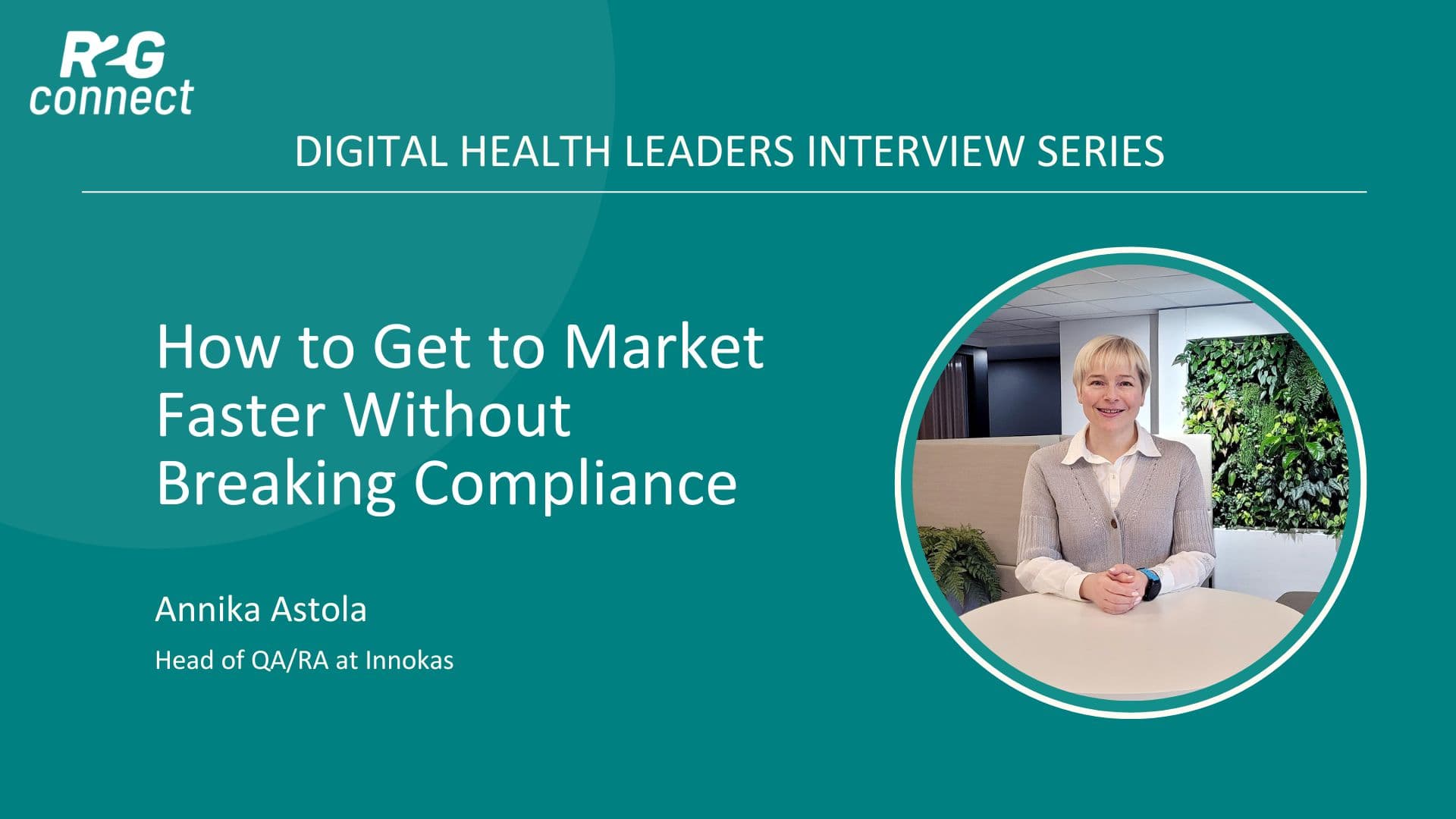
Key Takeaways:
- Start documentation from day one, don’t try to recreate it later
- Define regulatory strategy early and tie it to your business plan
- Don’t lock your design too soon, optimize for manufacturing first
- Build for real clinical workflows, not just technical performance
- Focus on a lean MVP, cut non-essential features early
- Only enter validation when both product and documentation are fully ready
R2GConnect**: Many healthtech founders believe that once the technology works, they are halfway to market. **From your experience, what is the biggest misconception about medical device development?
Annika: A common misconception is that you can focus on building the product first and deal with documentation later, once you’re ready for CE marking or market clearance. Many founders are deeply committed to developing the solution itself, and documentation often falls outside their comfort zone.
However, taking that approach can be both costly and risky, especially if the product is intended to be a medical device. The reality is that the design process must be documented from the very beginning. It’s extremely difficult to recreate that documentation retrospectively. Whether you’re targeting CE marking in Europe, FDA clearance in the U.S., or other markets, regulatory standards require that the device is developed in a structured, compliant way. This means following a defined product realization process, starting with documenting user needs. At that early stage, you should already be identifying potential risks and considering how to mitigate them through design.
The process also involves clear development stages and decision points from concept to design inputs and through the full design phase. Ultimately, the most efficient path to market, and to successful certification, is to build documentation alongside the product, not after it. That’s often the biggest hurdle founders underestimate.
At what point should startups start thinking about regulatory strategy, and what happens if they wait too long?
Annika: It’s very beneficial for startups to start thinking about and documenting their regulatory strategy as soon as their concept is defined enough to outline its intended purpose. At that stage, they should be able to identify who the users are, where the device will be used, the intended indications, the expected clinical benefits, and which markets they plan to enter. Having this clarity early on helps guide development in the right direction.
As the design progresses, a well-defined regulatory strategy ensures that the relevant requirements are built into the product from the start. It also supports the translation of user needs into clear design inputs. Starting early makes the entire process more efficient and reduces the risk of having to make costly changes later.
I also strongly believe that regulatory strategy shouldn’t be treated as something separate, it should be closely integrated with the overall business strategy. In practice, the two should go hand in hand.
Many founders struggle with the question: EU or US first? What factors should actually drive this decision?
Annika: Achieving CE marking in Europe or FDA clearance in the U.S. doesn’t automatically translate into market adoption or sales. That’s why the decision shouldn’t be driven solely by which pathway is faster or easier. Founders need to start by understanding the problem they are solving within the clinical workflow and where the real market need is. Where does their solution fit best? Who are the users, and which clinical processes does the product support most effectively?
It’s also essential to consider the commercial side: who will pay for the solution, who makes the purchasing decision, and how procurement actually happens in that market. These factors are just as important as regulatory approval because clearance is only the first step.
Another key point is that market entry is rarely as simple as “EU vs. U.S.” Both regions are highly fragmented. In Europe, you need to focus on specific countries and even regions within them. In the U.S., the market is vast and relationship-driven, requiring strong local presence and connections with hospitals and clinics. So rather than thinking in broad geographic terms, startups should focus their efforts where they can create the most value and realistically build traction.
Where do companies tend to underestimate the importance of design for manufacturability, and how does that impact them later in the product lifecycle?
Annika: A common challenge we see is that teams are often too quick to freeze the design and move forward into verification, validation, and manufacturing. In doing so, they may overlook important refinements that would improve manufacturability such as optimizing the design for production or ensuring that component sourcing is reliable and sustainable.
As a result, when they reach later stages like design validation or begin scaling up manufacturing, issues start to emerge. If the design isn’t robust or optimized, companies often have to go back and make corrections, which leads to additional time and cost. Ultimately, the difficulty lies in keeping the entire product lifecycle in mind. It’s easy to optimize for one phase, but if that comes at the expense of later stages, it can create significant setbacks.
AI is now everywhere in healthtech. Where do you see real regulatory progress, and where is hype still ahead of reality?
Annika: It’s always a bit difficult and perhaps even political to draw a clear line between what is hype and what is real when it comes to AI, especially given how many solutions and service providers are emerging in this space. From a regulatory perspective, I do see real value in using AI to make processes more efficient. For example, in clinical evaluation, there is a need to conduct extensive literature reviews. There are already strong AI tools that can analyze large volumes of data and support specialists in compiling and summarizing clinical evidence. In that sense, AI is making tangible progress.
At the same time, it’s important to be thoughtful about how AI is used. If companies want to apply AI in regulated environments, it’s best to rely on tools that are purpose-built for specific use cases, particularly those designed for regulatory or clinical workflows.
So, while AI should absolutely be leveraged to improve efficiency, it needs to be applied carefully. Using general-purpose tools alone is often not sufficient. Instead, the focus should be on solutions that are specifically developed and validated for these kinds of applications.
If a startup wants to add AI to an existing product later, what should they design for today?
Annika: It might seem slightly off topic, but I actually discussed this recently with a notified body representative. We were talking about the growing number of AI-related standards and what regulators might expect from medical device companies in this space. What we agreed on is that, rather than focusing too early on specific AI standards, companies should prioritize following established best practices in software development from the start. That already takes you a long way even when AI is involved.
For example, applying the medical device software lifecycle standard (IEC 62304) is essential. This includes structured processes for development, maintenance, risk management, and configuration management. Similarly, using a purpose-built system for requirements management and ensuring full traceability in verification are key foundations. It’s also important to maintain clear and up-to-date documentation, including your IT architecture and software development plans.
When it comes specifically to AI, companies should begin by familiarizing themselves with frameworks like the EU AI Act. Even though it’s not yet fully applicable to medical devices, it already reflects the expected state of the art. It highlights important considerations such as human oversight, transparency, and bias management areas that are increasingly expected to be addressed. Quality of data is essential to ensure AI devices perform as expected. Therefore, a structured process for dataset creation should be employed from the beginning to make sure data is fit for purpose. From there, these considerations can be integrated into your quality management system and design process, starting again from user needs and flowing through to technical documentation. There are also several AI-specific standards available. While they are not mandatory, they can be useful if they add value to your development process.
What is your approach when supporting companies with clinical, usability, or performance validation?
Annika: Our approach always starts with ensuring that neither the product nor the technical documentation is rushed into the validation phase before they are truly ready. The two typically evolve in parallel, and both need to reach a sufficient level of maturity before validation begins.
When you enter validation, the expectation is that the product is essentially final. At that stage, changes should be minimal. Validation is not about testing and then going back to redesign, it’s about confirming that the device performs as intended against predefined objectives. This means that key elements must already be in place. The verification phase should be completed, the risk management file should be up to date, and documentation such as the General Safety and Performance Requirements (GSPR) should be well developed.
One of our recent projects is a good example of smooth usability validation phase where time was also saved in the market clearance stage. In this case, the usability file was built according to IEC 62366‑1, and human factors validation testing was additionally conducted in the US with 15 test subjects, taking into account FDA guidance. As a result, the FDA did not raise any additional usability‑related questions or requests during the 510(k) review.
If you could give healthtech founders only three pieces of advice before they start medical device development, what would they be?
Annika: First, you need a deep understanding of your end users. Who will actually use the device? Who makes the purchasing decisions? What does the clinical workflow look like, and what problem are you truly solving? Having clarity on these questions is essential from the very beginning.
Second, focus on building a minimal viable product. It’s important to strip away any “nice-to-have” features and concentrate only on what is necessary to deliver value to your first users. If you can create something that solves their problem well, you can always build on it later. Keeping the initial scope lean also helps control both cost and complexity.
Third, develop your regulatory strategy early and make it an integral part of your business strategy. These two should not be treated as separate tracks they need to move together. Aligning them from the start will help you make better decisions and avoid costly detours later on.
R2GConnect: Thank you very much for your insights, Annika.
De-Risk Medical Device Development Whether you are starting a new medical device project or developing regulated medical software, early decisions around compliance and development strategy shape everything that follows. Explore Innokas’ special offers designed to help teams de-risk that journey from day one.