
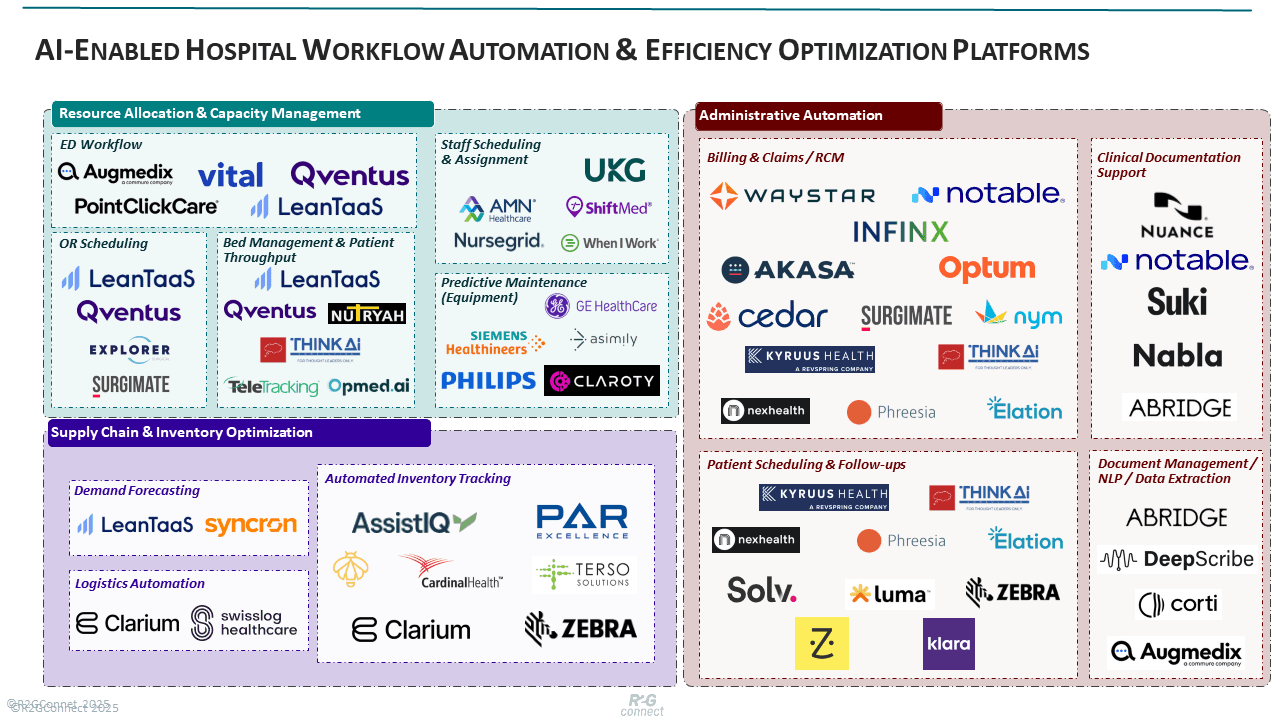
Hospitals run on flow. Beds, staff, supplies, OR slots, labs, documentation — it's all a giant, interdependent machine. When one gear slows, the whole system grinds. And in 2025, that machine is feeling the pressure: chronic workforce shortages, expensive equipment, growing patient volumes, and a never-ending pile of admin tasks. AI-enabled workflow automation tools promise to becoming the new “infrastructure layer” that hospitals rely on to run smoothly. These platforms don’t replace clinicians. They do something far more practical: take the grunt work off the table, predict issues before they explode, and keep operations humming with fewer bottlenecks. Here’s a breakdown of the three major categories shaping AI-enabled hospital workflow automation today.
1. Resource Allocation & Capacity Planning
These solutions orchestrate staff, beds, ORs, and equipment the same way an airline manages flights: with real-time predictions, automated scheduling, and smart routing. The goal is simple: maximize throughput, minimize chaos. Every percentage of improved utilization equals millions saved and hours returned to clinicians. This is where hospitals see the fastest and most measurable ROI.
Key Use Cases & What AI Actually Does
Operating Room (OR) Scheduling
ORs are high-value assets that lose money every minute they sit idle. AI steps in as a predictive coordinator, analyzing historical case durations, surgeon patterns, block utilization, and real-time delays to generate far more reliable schedules. Instead of static calendars, these systems continuously learn from actual performance, predicting overruns, identifying when a case is likely to cancel, and reshuffling the schedule hours or even days before the disruption hits. The result is a dynamic flow of cases that maximizes surgical throughput without burning out teams. Representative Solutions: LeanTaaS (iQueue for OR), Qventus, Surgimate, ExplORer Surgical (GHX)
Bed Management & Patient Throughput
Patient flow is the bloodstream of the hospital, and AI acts as the circulatory control center. These tools analyze real-time admissions, historical LOS patterns, clinical notes, discharge readiness signals, and bottleneck risks to forecast which beds will free up and when. Rather than relying on last-minute coordination, AI predicts discharge times, highlights units at risk of overflow, and recommends actions to prevent logjams before they happen. It turns bed management from reactive firefighting into a proactive, smoothly orchestrated system. Representative Solutions: TeleTracking, Think AI, NUTRYAH, Opmed AI, Qventus, Hospital IQ (LeanTaaS)
Emergency Department (ED) Workflow
The ED is unpredictable by nature, but AI makes it far less chaotic. It analyzes crowding patterns, patient acuity, triage inputs, staffing levels, and wait-time trends to anticipate surges hours in advance. Instead of discovering overcrowding when it’s already too late, AI flags incoming bottlenecks early, recommends patient routing strategies, predicts time-to-provider, and helps prioritize cases more objectively. It becomes a real-time command layer that helps ED teams stay ahead rather than constantly playing catch-up. Representative Solutions: Qventus ED Automation, Vital, PointClickCare, TriageGO, Augmedix ED
Staff Scheduling & Assignment
Scheduling is a painful blend of guesswork and negotiation — until AI takes over. By analyzing historical census levels, acuity scores, seasonality, clinician skill sets, and individual workload patterns, AI forecasts staffing needs with far better accuracy. It then uses optimization models to generate balanced shift assignments that reduce fatigue, ensure skill coverage, and avoid the last-minute scrambles that exhaust staff. Instead of forcing nurse managers to play Tetris with shifts, AI provides a data-driven, fair, and efficient staffing blueprint. Representative Solutions: UKG (Kronos), ShiftMed, NurseGrid (HealthStream), AMN Healthcare, When I Work
Predictive Maintenance (Equipment)
Equipment failure isn’t just inconvenient — it can derail entire care pathways. AI steps in by analyzing sensor outputs, usage logs, vibration patterns, temperature fluctuations, and maintenance history to detect subtle anomalies that predict failure long before a human would notice. This foresight allows teams to schedule repairs during low-impact windows, extend asset life, and avoid catastrophic downtime that stalls diagnostics and surgery. AI shifts maintenance from “fix it when it breaks” to “fix it before it becomes a problem.” Representative Solutions: GE HealthCare OnWatch, Philips PerformanceBridge, Siemens Healthineers teamplay, Medigate (Claroty), Asimily
2. Supply Chain & Inventory Optimization
Every hospital CFO knows: operational waste eats margins alive. AI supply chain tools deliver some of the quickest cost reductions across the hospital ecosystem. These tools forecast demand, automate purchases, track supplies in real time, and even use robots to move goods around the hospital.
Key Use Cases & What AI Actually Does
Demand Forecasting
Hospitals are notoriously bad at knowing what they’ll need next week, let alone next quarter. AI solves this by mining historical consumption, procedural schedules, case mix shifts, seasonal illness trends, and even external epidemiological data. It identifies patterns humans miss and produces demand forecasts that prevent both stockouts and expensive over-purchasing. By adjusting reorder points dynamically, AI transforms the supply chain from a guessing game into a predictable, data-driven process. Representative Solutions: LeanTaaS (iQueue), Syncron
Automated Inventory Tracking
AI quietly eliminates one of the most tedious jobs in healthcare: counting supplies. Using RFID signals, computer vision scans, cabinet sensors, and usage analytics, these systems keep real-time tabs on every item without requiring staff to lift a finger. They detect abnormal usage, trigger replenishment automatically, and flag fast-depleting items before they cause delays in care. Hospitals using AI-driven tracking have seen waste drop dramatically because the system always knows what’s missing — and why. Representative Solutions: PAR Excellence, Terso Solutions, WaveMark (Cardinal Health), Cognosos, Zebra Technologies, Clarium, AssistIQ
Logistics Automation
Inside a hospital, moving goods eats up far more staff time than anyone admits. AI-powered AMRs solve this by navigating halls, avoiding obstacles, optimizing routes, and self-assigning tasks based on real-time demand. They run labs at night, deliver meds on demand, and haul supplies without pulling nurses away from patients. These intelligent logistics systems reduce unnecessary human motion and tighten workflows in ways that feel almost invisible — until you realize how smoothly everything is moving. Representative Solutions: Clarium, Swisslog Healthcare Robots
3. Administrative Automation
If you free clinicians from paperwork, they give it back to patients. This is the category with the highest human impact and the fastest clinician adoption curve. These tools combine NLP, machine learning, and RPA to eliminate repetitive tasks, clean data, and support clinical documentation with minimal manual input.
Key Use Cases & What AI Actually Does
Billing & Claims Processing
Revenue cycle processes bleed hours because they depend on manual data entry and rules checking. AI cuts through this mess by reading documents, extracting structured data, detecting coding inconsistencies, predicting which claims are likely to get denied, and routing them for correction before submission. Instead of discovering errors months later, hospitals catch them instantly, speeding up cash flow and reducing administrative bloat. It’s the kind of automation no finance team says no to. Representative Solutions: AKASA, Waystar, Cedar, Notable, Change Healthcare (Optum), Infinx, Nym Health, Surgimate, Think AI, Elation Health, Phreesia, kyruus Health
Patient Scheduling & Follow-Ups
Scheduling is tedious precisely because it’s repetitive, rules-based, and prone to delays — which makes it perfect for AI. These tools analyze provider calendars, expected visit durations, patient preferences, and no-show risk to offer smart appointment slots without human oversight. They follow up with reminders, rescheduling prompts, and post-visit tasks using conversational AI. The result: fewer missed appointments, smoother workflows, and staff freed from endless phone-tag. Representative Solutions: Zocdoc for Health Systems, Luma Health, Elation Health, Phreesia, Klara, NexHealth, Solv Health, Think AI, Zebra Technologies
Document Management & NLP Data Extraction
Hospitals are drowning in PDFs, faxes, and scanned documents, and AI is finally pulling them to the surface. Using OCR, entity extraction, pattern recognition, and medical language models, these systems convert messy text into clean, structured data that flows straight into the EHR. Instead of manually combing through pages, staff get ready-to-use insights in seconds. It’s data cleaning at a scale humans simply can’t match. Representative Solutions: kyruus Health, Abridge, DeepScribe, Augmedix, Corti
Clinical Documentation Support
Clinicians spend too much time typing, and AI is the closest thing they’ve had to a digital scribe that doesn’t complain. It listens to the encounter, transcribes in real time, summarizes the interaction, and structures the note according to clinical and billing requirements. The system identifies key concepts, suggests codes, and reduces the dreaded after-hours documentation backlog. AI gives clinicians time back — and at this point, that’s worth more than any fancy new device. Representative Solutions: Nuance DAX, Abridge, Suki AI, Nabla Copilot, Notable, 3M M*Modal
Are You Building a Hospital Workflow Automation Solution?
Workflow automation isn’t a “nice-to-have.” It’s the backbone of the next generation of hospital operations — leaner, faster, safer, and far less chaotic. If your startup is helping hospitals run smarter, faster, and with fewer operational headaches, this is your moment. R2GConnect is running an open call for Hospital Workflow Automation & Operational Efficiency Platforms , and we’re actively scouting the next generation of tools that boost performance, cut waste, and take pressure off clinical teams. Apply now!